
Two Types of Belly Fat You Need to Understand
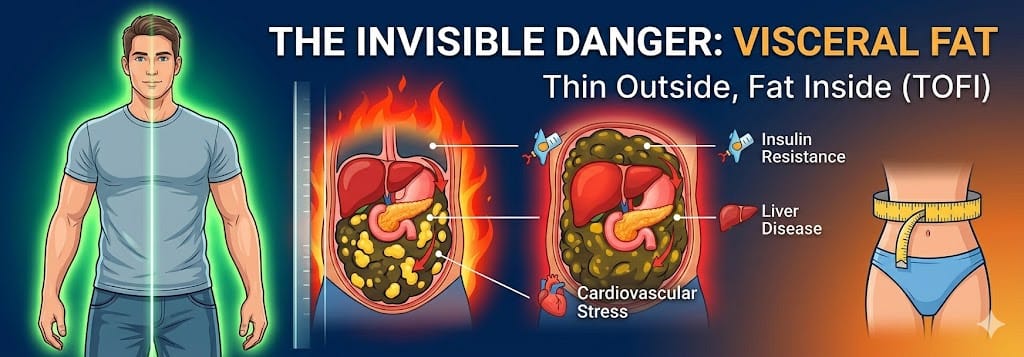
I haven’t seen a single online Health Guru or Influencer discuss this vital fact. There are 2 types of belly fat and they are not the same; there is subcutaneous, relatively superficial belly fat and there is a deeper fat deposited around one’s internal organs called visceral fat — a distinction that underlies many of the most overlooked weight loss mistakes people make when trying to improve their metabolic health.
While both are types of adipose tissue, subcutaneous abdominal fat and visceral fat are biologically and functionally distinct organs. In the context of 2026 metabolic science, the distinction is no longer just about “location,” but about how each type of fat communicates with the rest of your body.
At a Glance: The Primary Differences Between the 2 Types of Belly Fat
| Feature | Subcutaneous Fat (SAT) | Visceral Fat (VAT) |
|---|---|---|
| Location | Just beneath the skin (pinchable). | Deep in the abdominal cavity, wrapping organs. |
| Primary Function | Energy storage, insulation, and protection. | “Active” endocrine organ; metabolic signaling. |
| Measurement | Calipers, “pinch test,” or simple observation. | CT, MRI, DEXA scans, or waist-to-hip ratio. |
| Metabolic Impact | Generally neutral (unless in extreme excess). | High Risk: Linked to insulin resistance & disease. |
Subcutaneous Fat: The Pinchable Layer
Subcutaneous adipose tissue (SAT) is the most visible of the 2 types of belly fat, making up roughly 90% of total body fat for most individuals. This is the fat you can feel at your waistline, often referred to as “love handles” or a “muffin top.”
- Protective Roles: It acts as a shock absorber for muscles and bones, provides thermal insulation, and serves as a stable energy reservoir.
- The “Safe” Depot: Biologically, SAT is considered a “safe” storage site. It is less metabolically active and tends to store fatty acids in a way that doesn’t interfere with organ function. In fact, moderate amounts of subcutaneous fat in the hips and thighs (gynoid fat) are often associated with a lower metabolic risk in women — a pattern driven in part by sex hormone balance in women, particularly the interplay of estrogen and progesterone.
Visceral Fat: The “Active” Deep Fat
Visceral adipose tissue (VAT) is hidden behind the abdominal wall and tightly packed around vital organs like the liver, pancreas, and intestines. This is often called “active fat” because it behaves more like an endocrine gland than a storage tank.
- The Portal Circulation Connection: This is a critical scientific distinction. Unlike subcutaneous fat, which drains into general systemic circulation, visceral fat drains directly into the portal vein.
- Liver Impact: This means free fatty acids and inflammatory signals (cytokines) from visceral fat go directly to the liver. This direct path triggers:
- Insulin Resistance: The liver becomes less responsive to insulin.
- Dyslipidemia: Increased production of “bad” LDL cholesterol and triglycerides.
- Systemic Inflammation: Continuous release of pro-inflammatory markers like IL-6 and TNF-alpha.
Approaches like intermittent fasting for weight loss have shown particular promise in reducing visceral adipose tissue specifically, owing precisely to its high metabolic activity compared to subcutaneous fat.
Why Visceral Fat Is More Dangerous
Even if two people have the same Body Mass Index (BMI), the one with a higher proportion of visceral fat faces significantly higher health risks. This is why some individuals are referred to as TOFI (Thin on the Outside, Fat on the Inside). When comparing the 2 types of belly fat by health risk, visceral fat consistently drives the most serious outcomes, a pattern well documented in Harvard Health’s research on abdominal obesity and disease.
- Cardiovascular Disease: VAT increases blood pressure and arterial stiffness.
- Type 2 Diabetes: The chronic inflammation and liver-fat loading directly impair glucose metabolism.
- Dementia Risk: Recent 2025–2026 studies suggest a strong correlation between high VAT/SAT ratios and an increased risk of cognitive decline and Alzheimer’s.
- Cancer Link: Visceral fat produces growth factors that may encourage the development of certain cancers, particularly colorectal and breast cancers.
Who Is Most at Risk for Visceral Fat Accumulation?
This is where it gets personal. Visceral fat doesn’t accumulate randomly — it follows specific biological patterns that most standard physicals completely miss. Based on current metabolic science, the highest-risk profiles are:
- Men over 40: Testosterone decline directly correlates with visceral fat accumulation. As T drops, VAT rises — it’s not just about calories.
- Postmenopausal Women: The hormonal shift away from estrogen dominance causes fat redistribution from subcutaneous (hips and thighs) to visceral (abdomen). This is why waistlines change at menopause even without weight gain.
- Chronic Stress Carriers: Elevated cortisol is one of the most potent drivers of visceral fat. Cortisol signals the body to preferentially store fat around the organs — a survival mechanism that becomes deeply destructive in modern chronic-stress environments.
- Sedentary Individuals with “Normal” BMI: This is the TOFI group — Thin on the Outside, Fat on the Inside. Harvard Health’s research on targeting belly fat confirms that normal-weight individuals can carry dangerous levels of visceral fat that are completely invisible to the scale or a standard BMI calculation.
- Poor Sleepers: Less than 6 hours of sleep per night has been shown to significantly increase visceral fat deposition, independent of diet and exercise habits.
How to Measure the Distinction
Since you cannot “eyeball” visceral fat accurately, clinical tools are necessary for a precise measurement of the 2 types of belly fat. The Mayo Clinic’s guidance on belly fat and health risk provides a useful clinical framework, and imaging-based assessment offers even greater precision.
- DXA (DEXA) Scan: Modern 2026 DEXA software can specifically isolate the “android” region and calculate a precise VAT/SAT ratio.
- CT and MRI: These remain the “gold standard” for imaging the exact volume of deep fat surrounding the organs.
- Anthropometric Cues: While less precise, a Waist-to-Hip Ratio (WHR) of > 0.9 for men or > 0.85 for women is a strong indicator that visceral fat is accumulating at a dangerous level.
Your Biological Performance Audit
Understanding your fat distribution is the first step toward a precision health intervention. At the Age Reversal Technology Center, we don’t just look at the scale — we look at the “hidden” fat markers that dictate your future health. Advanced therapies, including peptide therapies for metabolic optimization and age reversal, are increasingly used alongside body composition analysis to address the root causes of visceral fat accumulation.
Visceral fat is a “silent” driver of biological aging. If you’re ready to understand which of the 2 types of belly fat is driving your health risk and what it means for your long-term health, get started with our medical weight loss program at the Age Reversal Technology Center, or call us at 941-806-5511 to schedule your “Metabolic Blueprint Audit.”

OFFICE HOURS
Monday
10:00am – 5:00pm
Tuesday
10:00am – 5:00pm
Wednesday
10:00am – 5:00pm
Thursday
10:00am – 5:00pm
Friday
10:00am – 4:00pm
Saturday and Sunday
Closed

