
Peptide Therapy in Sarasota, FL
Peptides are all over social media and the internet over the past several months. They have gotten easy to buy with dozens of companies selling ‘research grade’ peptides. That’s the part everyone notices. What almost nobody thinks about until later is that buying a peptide and running a peptide protocol are two different activities — and only one of them involves anybody checking whether it’s the right molecule, at the right dose, for a problem you actually have.
At the Age Reversal Technology Center, every peptide protocol is designed and supervised by Dr. Max MacCloud, built on your bloodwork, and adjusted as your numbers move.
What Peptides Actually Are
Peptides are short chains of amino acids — anywhere from two to fifty-plus aminos linked together— that act as signaling molecules. If DNA is the hard drive, peptides are the command lines that tell a cell what to do next. Your body already produces thousands of them. They are used to turn on or turn up a signal that is not strong enough.
That’s what makes them different from hormones. A hormone like testosterone is a broad instrument affecting hundreds of systems at once. A peptide is targeted: it binds a specific receptor and triggers a specific downstream response.
Peptide medicine isn’t fringe, it’s the future. Insulin is a peptide. So are the GLP-1 medications now in widespread use. More than eighty peptide drugs hold full FDA approval. Many others will never go through approval — not because they don’t work, but because unpatentable molecules can’t justify the billion-dollar cost of the approval pathway.
The catch: most of what circulates online is self-experimentation. People inject research-grade material that they attest that they are not for human use, with no view of how compounds interact, what their labs say, or whether the molecule addresses their actual problem.
Our Six Primary Peptide Protocols
We organize peptides by the problem being solved, not by molecule. Which protocol fits — and which peptides go in it — depends on your labs, history, and goals.
PROTOCOL 01
Healing and Regeneration
For a wide array of musculoskeletal issues, including post-surgical recovery, chronic injuries, and soft-tissue damage that hasn’t responded to conventional care.
A dosing note most suppliers get wrong: BPC-157 and TB-500 are frequently sold premixed in one vial. That’s incorrect. TB-500 works best as a higher bolus once or twice weekly, while BPC-157 is daily. We recommend that they be taken separately at least for the first few rounds. After that, the combination product is totally acceptable.
- BPC-157 — “Body Protection Compound,” a 15-amino-acid sequence found in gastric juice. The proposed mechanism is angiogenesis and growth-factor upregulation: rather than masking the pain of a damaged tendon, signaling the body to rebuild the scaffolding. The musculoskeletal research to date is largely preclinical, and we’ll say so — it is promising, not settled.
- TB-500 (Thymosin Beta-4) — if BPC-157 is the local builder, TB-500 is the systemic architect, supporting tissue regeneration and getting repair cells where they’re needed.
- Often combined with KPV (anti-inflammatory) and GHK-Cu (collagen and wound healing).
- If cartilage is involved we recommend Cartalax, a bioregulator peptide that targets cartilage repair.
PROTOCOL 02
Fat Loss and Metabolic Balance
For metabolic resistance — where calorie restriction alone has stopped working.
The muscle problem nobody mentions. Across weight-loss interventions, roughly 20–40% of the weight lost is lean tissue, not fat. In the STEP 1 body-composition data, participants lost about 23 lb. of fat and 15 lb. of lean mass. A smaller, weaker version of yourself is not the goal. Every fat-loss protocol here is built with protein targets and resistance training from day one — not bolted on after the damage. These two interventions will completely halt the loss of muscle mass.
- GLP-1 medications — semaglutide (roughly 15% body weight over 6–12 months in trial data) and tirzepatide, a dual GLP-1/GIP agonist (approximately 20–22.5%). Both FDA-approved. See our semaglutide program.
- Retatrutide — the third generation of the GLP-1s. It is a triple agonist (GLP-1, GIP, glucagon). Currently investigational and available only through an observational research study. Ask us about how to enroll. Based on several months of working with this peptide on hundreds of people we believe it provides many benefits and the research is bearing this out.
- MOTS-c — a mitochondrial-derived peptide supporting insulin sensitivity, mitochondrial function and biogenesis. It tells the body to build more engines and helps to tune them up.
- SS-31 (elamipretide) — repairs damage to the inner mitochondrial membrane. We generally sequence SS-31 with or before MOTS-c because you shouldn’t try to tune an engine with a cracked block.
- Tesamorelin, AOD-9604, and CJC-1295/Ipamorelin to preserve lean mass during a deficit.
PROTOCOL 03
Microvascular Repair
Vascular health underlies everything — heart, brain, sexual function, hair growth, and how well any other therapy reaches its target.
We’ll be straight about the evidence here: The vast majority of research on these bioregulator peptides was done in Russia over the past 50 years. That data clearly shows that they are safe and effective. Western medical research on humans is early and comes largely from a narrow research tradition. These are naturally occurring peptides, therefore they cannot be patented which means little to no research money. The reasoning is sound, and it’s why microvascular health sits at the top of our assessment framework — but you should know where the evidence stands. Please note that we don’t rely on peptides alone to help your body repair. Peptides are amazing but your body still needs all the right raw materials for the cells being signaled to do their job. EWOT is one of the top things a person can do to help open and reset the microvascular system throughout the body’s 60,000 plus miles of capillaries.
- Vesugen and Cardiogen — bioregulator peptides aimed at endothelial and cardiac tissue.
- BPC 157 & TB 500 are also appropriate to assist with microvascular repair.
PROTOCOL 04
Mitochondrial Repair
The engine overhaul, for fatigue, poor recovery, foggy thinking, and low stamina.
SS-31 repairs the inner mitochondrial membrane that gets damage in everyone; MOTS-c then raises energy output of the mitochondria while stimulating production of new mitochondria. Typically paired with EWOT and specific nutrient repletion — mitochondria need certain cofactors present to function at all.
PROTOCOL 05
Brain and Nerve Repair
Cognitive decline is frequently a shortage of repair signaling rather than an inevitability.
Cerebrolysin, Selank, and Semax act as neurotrophic factors supporting focus, memory, and nerve regeneration. For nerve damage such as peripheral neuropathy, we add ARA-290, which has been shown to support nerve regeneration, as part of a broader neuropathy protocol.
Other peptides that can also help include Dihexa (orally) and Adamax (nasal spray).
PROTOCOL 06
Immune Support
The thymus — the master gland of the immune system — begins shrinking after puberty.
Thymosin Alpha-1, Thymulin/Thymalin, and LL-37 support immune resilience. Thymosin Alpha-1 has one of the longest clinical track records of any peptide in use.
Crystagen is another peptide that has been shown to support immune balanced function.
Growth Hormone Support Without Injecting HGH
As you age growth hormone output drops substantially, contributing to muscle loss, abdominal fat, skin changes, recovery ability, healing, and a host of other functions.
Injecting HGH directly suppresses your own production, and it is also both expensive and difficult to get. The DEA classified it as an anabolic steroid which it is NOT, but they did it to make it harder for doctors to prescribe. We use secretagogues instead — peptides that prompt your pituitary to release growth hormone in its natural pulsatile pattern:
- Ipamorelin — a selective secretagogue that stimulates pulsatile GH release without spiking cortisol or prolactin
- CJC-1295 (without DAC) — a GHRH analogue allowing precise dosing
Used together they produce a sustained signal that approximates your body’s own rhythm, supporting lean mass, sleep quality, and recovery.
Hair and Skin Peptides
AHK-Cu (Copper Tripeptide-3)
Stimulates dermal papilla cell proliferation and upregulates VEGF — waking dormant follicles and supplying the blood flow they need. Integrated into our hair restoration program.
GHK-Cu
The reference standard for collagen synthesis and wound healing — structural integrity of your largest organ, not just cosmetics. Used in skin regeneration and microneedling protocols.
Why Peptides and Hormones Are Prescribed Together
Peptide signaling instructions land in whatever hormonal environment your body currently has. If testosterone, estradiol, or thyroid output are depressed or out of balance, you’re asking a cell to build in a system that isn’t in a building state.
The reverse holds too: restoring hormone levels doesn’t repair accumulated tissue damage or reverse mitochondrial decline on its own.
Sequencing is the clinical judgment. We frequently recommend correct a significant hormonal imbalance first or concurrently. Combining them provides a significant synergistic boost to the process. It also helps to have ones hormones balanced so the recommended peptide protocol gets to work with a stable baseline rather than an unstable and moving one. Same principle as SS-31 before MOTS-c — order determines whether the second intervention has anything to work with.
Interactions are real. Some peptides amplify each other; others conflict. Running a GH secretagogue while insulin is elevated mostly wastes the protocol, which is why metabolic markers get addressed before or alongside anything else.
Where Peptide Regulation Stands Right Now
Prospective patients ask, and the straight answer builds more confidence than a vague one.
Approval status and sourcing
Most peptides used in personalized therapy are not FDA-approved finished drugs and the vast majority never will be. The peptides we recommend are from vetted manufacturers with many years of experience in the field. We get COAs (certificates of analysis) on everything we recommend. The sources we use are the same ones that compounding pharmacies use. Contrary to what many people believe, compounding pharmacies DO NOT manufacture peptides. The process is far more complicated and requires over $1 million in equipment that compounding pharmacies simply do not have.
The July 2026 PCAC vote
In July 2026 the FDA’s Pharmacy Compounding Advisory Committee voted to recommend that six peptides — BPC-157, TB-500, MOTS-c, KPV, Epitalon, and Semax — be added to the 503A Bulks List governing what compounding pharmacies may prepare. A seventh, emideltide, also known as DSIP (deep sleep inducing peptide), was not recommended at this time although the research data is strong.
That vote is a recommendation, not a rule change. The FDA must still issue a proposed rule, take public comment, and publish a final determination. Until that concludes, these peptides remain in a transitional status.
What that means for you
We source from vetted manufacturers (the same place that compounding pharmacies use), we tell you which regulatory category any recommended peptide falls into, and we don’t represent compounded peptides as FDA-approved drugs. Where your protocol includes an approved medication, such as semaglutide, or tirzepatide we’ll say so.
Why Sourcing and Supervision Change the Outcome
Buy from an unregulated website and you have no guarantee of purity. You may be injecting heavy metals, fillers, or nothing at all. Plus, you are attesting that you will not be injecting them into yourself as most are not approved for human use. Again, there’s that pesky ‘approval’ issue.
We use pharmaceutical-grade compounds from vetted pharmaceutical manufacturers.
Beyond purity, stacking logic matters. The questions that determine whether this works are the unglamorous ones: What do your labs show? What are you already taking? What’s the actual goal? Who’s watching the numbers at three months and adjusting when they move?
A vial doesn’t answer any of that. The research grade peptide companies can’t answer any of that or advise you how to use them since they are for ‘research purposes only’ and ‘not for human use.’ Are Big Pharma and the government trying to scare you away from using peptides that are not approved? Absolutely, they cannot be patented in most cases, therefore they are in a gray area when it comes to funding and physician recommendations.
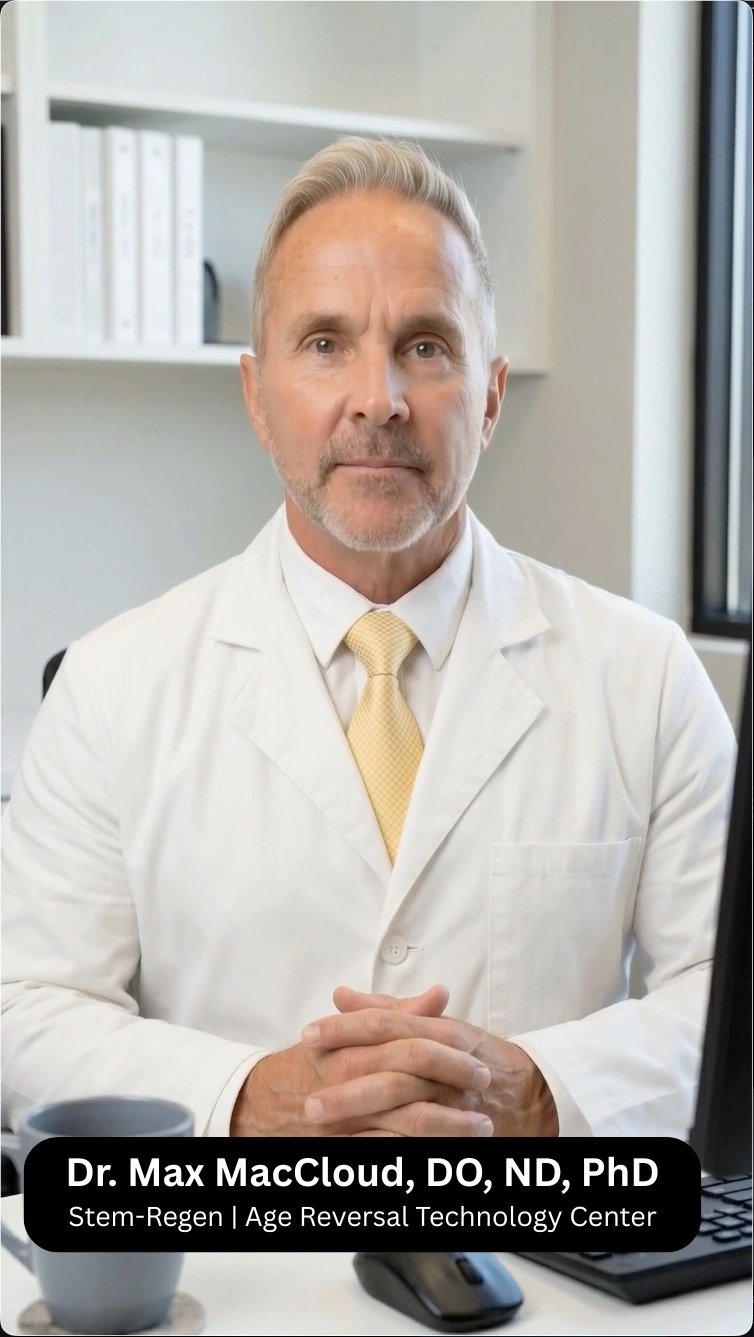
Meet Dr. Max MacCloud
A short introduction to the Age Reversal Technology Center.
What to Expect as a Patient
- 01Free Discovery CallA short phone conversation, no cost or obligation, to see whether a full consultation makes sense for you and you are a good fit for us. We choose to work with people who are motivated and engaged in improving their health and longevity.
- 02Comprehensive evaluationWe’ll discuss your health history, any challenges you are experiencing, and your health goals to come up with an initial plan. We like to have regular lab tests to help determine how your body is doing and how it is responding to the various interventions we might recommend to help you achieve your health, performance, and appearance goals. That means a comprehensive blood panel and any other tests deemed appropriate.
- 03Protocol designWe build a stack where each compound supports the others and sequence them correctly. You’ll know what’s recommended, why, how it’s administered, its regulatory status, and what it costs.
- 04Monitoring and adjustmentFollow-up labs tracking GH, IGF-1, hormones, and other metabolic markers, with dosing adjusted on real feedback. Peptides are rotated and re-stacked as you progress.
Most peptides are given by subcutaneous injection, usually self-administered at home after instruction. Some are oral, intranasal, or topical.
Who This Is For
Peptide therapy suits people who want to address the cause of a problem rather than manage its symptoms — an athlete speeding recovery, someone rebuilding after injury or surgery, a person over fifty who declines to accept slowing down as a settled matter.
It is not for someone looking for a single injection that replaces sleep, protein, and resistance training. We’ll tell you honestly at the evaluation if peptides aren’t the right lever for what you’re after.
Find Out Which Protocol Fits
Start with a free Discovery Call. If a workup makes sense, the evaluation gives you comprehensive consultation and an initial protocol built on your unique needs and goals.
Research and Regulatory Record
- PubMed Central“Stable Gastric Pentadecapeptide BPC 157 and Striated, Smooth, and Heart Muscle.”Read the paper →
- FDA PCAC · July 2026Committee voted to recommend six peptides — BPC-157, TB-500, MOTS-c, KPV, Epitalon, and Semax — for the 503A Bulks List. A recommendation, not yet a rule change.
- STEP 1 · Body compositionParticipants lost about 23 lb. of fat and 15 lb. of lean mass — the basis for building protein targets and resistance training into every fat-loss protocol here.
Frequently Asked Questions
Is peptide therapy FDA-approved?+
Some peptides are — semaglutide, tirzepatide, and tesamorelin are approved drugs. Most used in personalized therapy are compounded preparations that are not FDA-approved finished drugs. See the regulatory section above.
How are peptides administered?+
Most commonly by subcutaneous injection, self-administered at home after instruction. Some are oral, intranasal, or topical.
How long before I see results?+
It depends on the protocol. Recovery-focused work often shows change within weeks; metabolic and longevity protocols are assessed over months. We set expectations at protocol review rather than promising a date.
Are there side effects?+
Yes, as with any therapy — injection site reactions being most common. Peptide-specific risks are reviewed before you start, and monitoring is built in.
Can peptides be combined with hormone therapy?+
Yes, and frequently are. Both are managed by the same physician here, so sequencing is deliberate.
Does insurance cover peptide therapy?+
Generally not. Insurance covers what it deems medically necessary, and regenerative care usually falls outside that. Some FDA-approved medications may have coverage depending on your plan. We provide a good faith estimate.
Can’t I just order peptides online?+
You can. What you can’t get online is verified purity, a protocol matched to your labs, correct sequencing, or anyone monitoring your numbers three months in.