
Stem Cell Therapy Sarasota
Stem cell therapy uses mesenchymal stem cells and exosomes to signal damaged tissue to repair itself. It has gotten very popular in Sarasota, with many offices now offering this approach because it works. Clinics have appeared between the nail salons and the frozen yogurt shops, most of them selling a single injection for thousands of dollars and a handshake. Almost all have a one and done approach.
That is not what happens here.
At the Age Reversal Technology Center, stem cells and exosomes are one component of a systemic regeneration strategy — delivered where they are most needed from a joint, intranasally for the brain, via nebulizer for heart & lungs, of intravenously for a whole-body effect. We support the overall cellular environment with several additional things to optimize how well they work. The entire process is supervised by Dr. Max MacCloud [DO, ND, PhD].
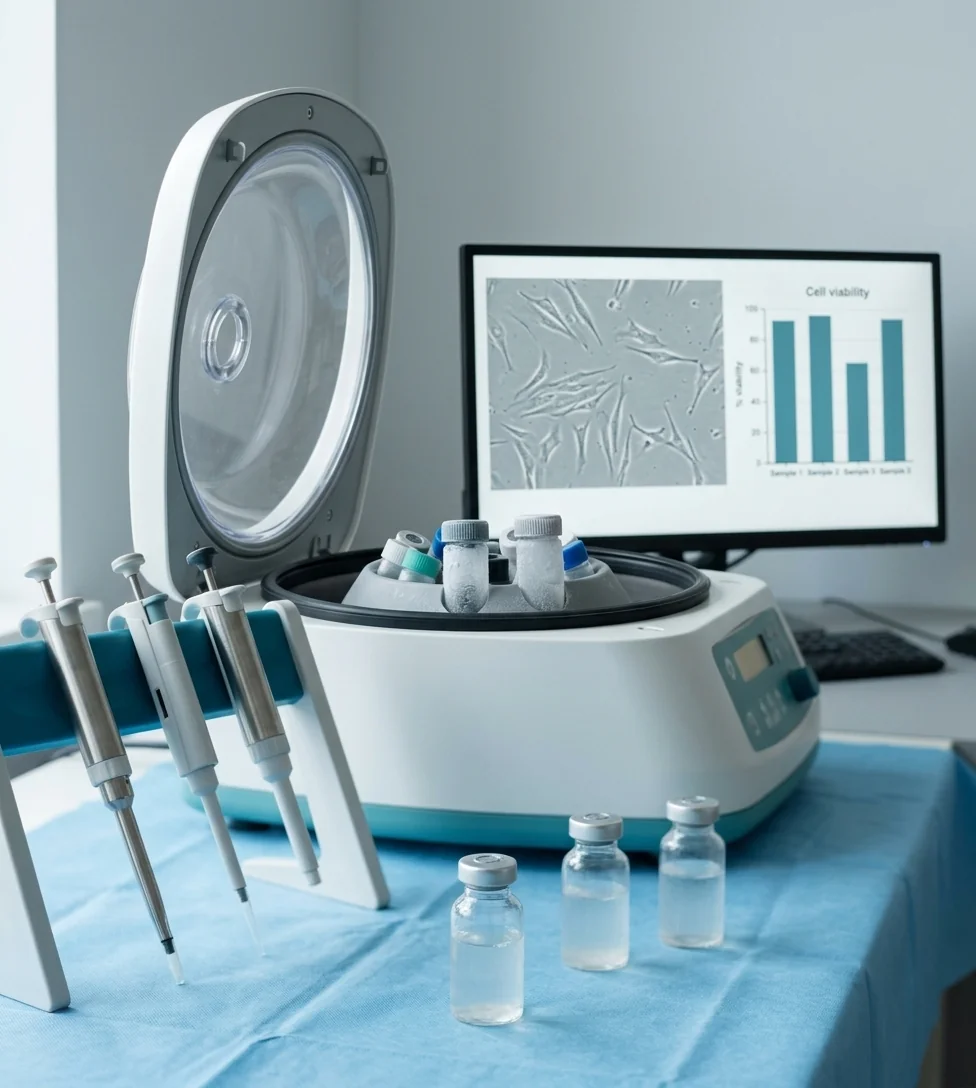
Stem Cells and Exosomes: What They Actually Do
The debate over stem cells versus exosomes is a false choice. They do different jobs, and they work best together.
Stem cells are the general contractor
Mesenchymal stem cells are living cells that direct tissue repair. The cells used at ARTC are sourced from umbilical cord and other post-birth tissues like placenta — their biological age is essentially zero.
Counter to what others might have told you, they do not directly become your tissue. They signal your own dormant stem cells to resume work, and they have been documented to transfer young mitochondria into your older existing cells as part of that revival. As you age, your stem cell population declines sharply and the cells that remain become less responsive. Introducing young, active cells restarts a process that has stalled.
There are two major effects from adding young, umbilical-derived stem cells and associated growth and repair factors. 1. They provide a ‘software’ update or reprogramming on the older cells. 2. They provide new battery packs (mitochondria) to the older cells which is likely one of the key things that helps to revive your existing stem cells.
Exosomes are the instruction set
An exosome is a nano-scale extracellular vesicle — a signaling packet released by cells, carrying growth factors, proteins, lipids and messenger RNA. When dealing with regenerative processes, we are referring to exosomes produced by stem cells. Note that a significant amount of the work done by stem cells is attributed to the exosomes that are contained in every stem cell (thousands of exosomes in every stem cell).
If stem cells are the contractor with the master plan, exosomes are the subcontractors supplying specific instructions, a lot of the labor, and most of the supplies. Much of the regenerative effect attributed to stem cells appears to come from the signals they release rather than from the cells themselves.
Because exosomes are non-living particles and extremely small, they carry practical advantages: broader tissue distribution, high signaling density in a small volume, and particular interest in protocols involving the nervous system, where their size may allow them to cross the blood-brain barrier more readily than whole cells.
Why we use both
- Stem cells contribute regenerative capacity by reviving, energizing, and activating your existing stem cells via their information and mitochondria updates
- Exosomes contribute signaling, growth factors, coordination and inflammatory modulation
- Repair without signaling is inefficient; signaling without repair capacity is limited
The science is still developing. Anyone claiming one is universally superior to the other is ahead of the evidence. Which combination makes sense depends on the tissue, the condition and the individual.
Why Intravenous Delivery Changes the Outcome
Most people picture stem cell therapy as an injection into a damaged joint. Localized injection has its place — and for musculoskeletal repair, it is covered under our non-surgical joint repair and prolotherapy program.
Intravenous delivery does something different. It impacts the whole system.
When stem cells and exosomes enter the circulation, they distribute through the bloodstream, detect chemical signals released by damaged tissue, migrate toward areas of inflammation or injury, and release repair factors that act on surrounding tissue and reactivate your own resident stem cells.
The practical consequence is that a single IV protocol can address several areas at once rather than one joint in isolation. An IV administration may also help a joint to heal but for larger joints like the knee, hip, and shoulders, it is often necessary to put them right where they are most needed.
Where systemic delivery matters most
Because of first-pass circulation, the cardiovascular system receives substantial exposure. The kidneys receive roughly a fifth of cardiac output, which gives them similar exposure. Areas commonly addressed in systemic protocols include:
- Cardiovascular function, including endothelial health and circulation to the extremities. A newer protocol uses nebulized stem cell to target the lungs and heart more directly.
- Kidney filtration and inflammatory load
- Immune modulation and chronic inflammation
- Cognitive clarity, energy and mood
- Metabolic function, including insulin sensitivity and mitochondrial output
- General musculoskeletal recovery and mobility
A patient presented with a measured ejection fraction in the 13–17% range. Following a course of systemic regenerative therapy alongside supporting protocols, that figure was later measured at 65%. A separate patient facing dialysis was able to avoid it.
These are individual examples offered to illustrate what systemic delivery is aimed at. They are not a promise, a typical result, or a claim that this therapy treats heart or kidney disease. Individual results vary.
No provider can lawfully promise an outcome. What we can do is explain the mechanism and assess whether you are a reasonable candidate.
Stem Cells Will Not Work in a Swamp
This is the part most clinics skip, and it is the reason their results often disappoint.
Introduced stem cells and exosomes depend on the health of the tissue they land in. If microcirculation is compromised, mitochondrial function is poor, blood sugar is unstable and nutrient status is inadequate, the cells arrive at an environment that cannot support them. The recipient environment is one of the primary determinants of whether stem cell therapy produces anything meaningful.
A clinic that offers an injection without assessing and working on your internal environment is not treating you. It is processing you.
The Wolverine Healing Protocol
Every regenerative protocol at ARTC is delivered alongside the support that makes it viable:
- Comprehensive nutritional support, so the raw materials for repair are present and bioavailable
- Photobiomodulation, to stimulate mitochondrial activity and collagen production
- Shockwave therapy to break up scar tissue & calcium deposits while stimulating circulation, angiogenesis, and collagen production.
- Joint decompression when appropriate (knees and spine).
- Peptide support is incorporated into our protocols because they work to support the repair process by providing specific biological instructions for cells to follow during repair (BPC 157 & TB 500),
- Oxygen therapies like EWOT, IHHT, and/or Hyperbaric oxygen therapy can also play a significant role when indicated. They help to enhance how the body processes and delivers oxygen to the hundreds of trillions of cells that make up the body. Oxygen is the most important nutrient and is needed for efficient energy production and therefore healing.
The objective is not to administer stem cells and hope. It is to make the body capable of using them.
Discuss Your Protocol with Dr. MacCloud
What the Process Looks Like
- STEP 01Assessment before anything elseWe like to evaluate your overall health whenever possible, and a person is up for it. We won’t force you to go through a complete evaluation including labs and specialized tests, but we certainly do encourage it. At the very least we’ll get a sense of your biological age vs. your chronological age to help determine how much support might be needed. Looking at things like inflammatory markers, EFA ratios, and hormones can really help us to support what’s needed. We strongly encourage people to allow us to assess their microcirculation (microvascular health), mitochondrial function and metabolic status. If your biology is working against you, an isolated intervention is a temporary measure at best and we’re looking for long-term health benefits.
- STEP 02Protocol designStem cells, exosomes, or both — the combination depends on the tissue involved, your goals and what the assessment shows. Supporting therapies are specified at the same time, not added later.
- STEP 03DeliverySystemic or localized delivery may be used depending on the situation and which method has the highest likelihood of success. Both are effective when used appropriately. Some situations are best addressed as a combination of systemic and localized delivery.
- STEP 04Support and reassessmentHealing takes time, raw materials and circulation. That’s why we emphasize the importance of multiple sessions vs. the one and done approach. We typically perform 6 or more injection sessions and provide follow up booster session as needed. These are the things that separates a program from a procedure.
Why Patients Choose ARTC
Sarasota has no shortage of clinics offering regenerative injections. It is a hot bed of innovative regenerative procedures compared to most communities. Here are some of the differences worth asking about:
- Source qualityBlood is not a credible source of stem cells or exosomes. If a provider draws your blood, spins it and returns it as stem cell therapy, you are receiving something else entirely. That is called PRP, which can be effective but it has a fraction of the healing capacity of stem cells or exosomes.
- A physical clinicSome providers run dinner seminars and dispatch a practitioner for a one-time injection. We are a fixed facility with ongoing patient relationships.
- Physician supervisionDr. Max MacCloud [DO, ND, PhD], Founder and Chief Medical Officer, designs and oversees every protocol.
- A complete strategyRegenerative therapy at ARTC sits inside our full program of services, not beside it.
The Mayo Clinic notes that stem cell research continues to advance as a legitimate avenue in regenerative medicine while cautioning that the quality of application varies widely between providers. That variance is the entire point. Mayo Clinic — stem cell therapy overview
Common Questions
Is stem cell therapy FDA approved?+
Yes, but only for several types of cancer, that’s what bone marrow transplant is used for, that is a low-dose stem cell procedure. As far as any other condition is concerned the answer is No. Stem cell and exosome therapies are not FDA approved to treat any specific conditions or applications, and no provider can lawfully claim a particular outcome. What we can do is explain the mechanism, assess whether you are a reasonable candidate, and be honest about what the evidence supports. There have been over 1.2 million published studies worldwide demonstrating the effectiveness and safety of stem cells &/or exosomes, but our ‘health care system and the FDA’ don’t work based on outside studies. They only consider specific studies done in conjunction with trying to get a new drug approved that a drug company is paying for. That costs big money, upwards of one billions dollars and no company will put up that kind of money for something that they can’t patent.
Stem cells or exosomes — which should I have?+
That depends on the tissue, the condition and your broader biology. Most ARTC protocols use both. Our assessment helps answers that question; a brochure cannot.
How does this compare to PRP?+
Standard platelet-rich plasma uses your own platelets, which means its potency tracks your own biology. Most PRP research was conducted on athletes in their twenties, when circulating growth factors and collagens are at their peak. By your fifties and beyond those levels are a fraction of what they were — which is precisely the age at which most people go looking for it.
ARTC offers both PRP and Nano PRP which is derived from placental tissue rather than from your own blood. If you are young and healthy, basic PRP has a good chance of success. We have the option of Nano PRP that has growth factors, collagens, and cytokines that do not depend on your current biology, which is the whole point of why Nano PRP might be a better option. It sits alongside stem cell and exosome protocols, and in localized applications the two are often used together.
How long before anything changes?+
Regeneration is not instantaneous. It requires time, nutrients and circulation to the treated area. Timelines vary by tissue and by an individual’s healing capacity. We prefer to set realistic expectations than an appealing one. For most people they will feel improvement during the first month with full benefits being achieved by the third month.
I have joint pain specifically. Is this the right page?+
Possibly not. For knee, back, shoulder, hip or neck repair, see non-surgical joint repair, which covers prolotherapy and targeted regenerative injection. Systemic IV therapy and localized joint repair are often combined.
Start With an Honest Assessment
Getting older is mandatory. Decaying is optional.
If you want to know whether regenerative therapy makes sense for your biology — and to hear it straight if it does not — the first step is an evaluation, not an injection.