
Fasting and Lifespan: The Metabolic Truth Behind Going Without Food
The Fasting Phenomenon
Fasting and lifespan have become tightly linked in modern health discussions. Fasting has gone from fringe practice to mainstream biohacking obsession faster than you can say “intermittent.” The claim? Periodically abstaining from food can extend your lifespan. It sounds ridiculous—we would assume that we evolved to eat regularly, after all—but the research is surprisingly compelling. Of course, like most things in health, the nuance is where the real story lives.
The reality is that our ancestors frequently missed meals and had sometimes extended periods of low intake and fasting.
The Science: What Happens When You Don’t Eat
Autophagy: Your Cells’ Housekeeping Service
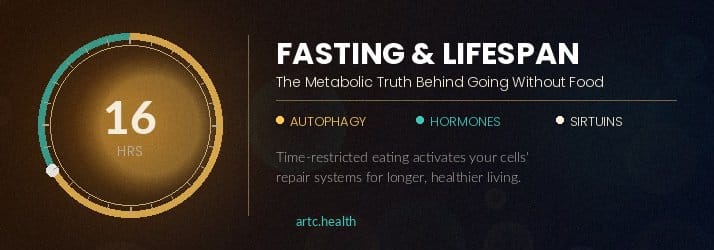
When you fast, your body doesn’t immediately enter “starvation mode” (that’s mostly mythology). Instead, glycogen stores deplete after about 12-16 hours, and your cells activate autophagy—literally “self-eating.” This isn’t as horrifying as it sounds. Your cells selectively break down damaged organelles, misfolded proteins, and cellular junk that accumulates with age.
Think of it as your cellular cleaning crew finally getting around to renovating the basement after months of neglect. This process is associated with reduced cancer risk, improved mitochondrial function, and enhanced longevity signaling pathways.
Metabolic Switching: The Metabolic Fuel Shift
After glycogen depletion, your body shifts from glucose metabolism to ketone production from fat stores. This isn’t inherently anti-aging, but ketones are a cleaner fuel source than chronic glucose dependency. They produce fewer free radicals, reduce inflammation markers, and enhance cognitive function in many individuals.
Hormone Optimization
Fasting influences multiple hormones associated with aging:
- Insulin decreases (reducing mTOR pathway activation)
- Growth hormone increases (supporting muscle preservation and fat loss)
- IGF-1 decreases (high levels associated with faster aging)
- Glucagon increases (mobilizing stored energy efficiently)
Sirtuin Gene Activation
Fasting activates sirtuins, particularly SIRT1 and SIRT3, which regulate cellular stress responses and mitochondrial function. These are often called “longevity genes,” and they’re activated by caloric deficit and metabolic challenges—exactly what fasting provides.
The Fasting Protocols: Which Actually Matter?
Time-Restricted Eating (16:8 or 14:10)
Eat all calories within an 8-10 hour window, fast for 14-16 hours. This is gentle, sustainable, and appears to offer many benefits without extreme sacrifice. Includes your time sleeping, making it relatively painless.
Evidence quality: Moderate. Metabolic improvements shown, but less dramatic than longer fasts.
Intermittent Fasting (5:2 or Eat-Stop-Eat)
Eat normally five days, restrict to 500-600 calories two non-consecutive days, or do complete 24-hour fasts once or twice weekly.
Evidence quality: Good. Multiple studies show metabolic benefits comparable to continuous caloric restriction.
Extended Fasting (3-7+ days)
Longer fasts trigger deeper autophagy and more profound hormonal shifts. Also more challenging and potentially riskier for certain populations.
Evidence quality: Limited in humans. Animal studies are promising, but human data is sparse. Requires careful medical oversight.
Periodic Fasting (monthly or quarterly)
Extended fasts spaced infrequently throughout the year.
Evidence quality: Minimal. Interesting concept, but lacks robust evidence.
The Uncomfortable Nuances
Fasting Isn’t Magic—Caloric Restriction Is
The real hero appears to be caloric deficit, not fasting per se. You can achieve similar metabolic benefits eating six small meals daily in a caloric deficit versus fasting intermittently while overeating during eating windows. The fasting approach just makes caloric restriction easier for many people.
Individual Variation Is Massive
Some people thrive on intermittent fasting; others experience increased cortisol, disrupted sleep, and metabolic suppression. Metabolic flexibility—the ability to switch between fuel sources—determines who benefits most. Insulin-resistant individuals often show better improvements than metabolically healthy people.
Women’s Hormones Complicate Things
Extended fasting can suppress reproductive hormones in women more readily than men. Menstruating women may experience worse results than men with identical protocols. This isn’t anti-fasting; it’s a call for individualization.
Fasting Doesn’t Solve Poor Nutrition
You can fast perfectly and still eat garbage during eating windows. The metabolic benefits disappear if you consume ultra-processed foods, excess sugar, and inflammatory oils during your eating period. Fasting amplifies the quality of what you eat—it doesn’t compensate for it.
What the Longest-Lived Populations Actually Do
The Blue Zones research reveals an interesting pattern: longevity populations don’t fast dramatically, but they do:
- Eat in caloric moderation (naturally, not through restriction)
- Have regular eating patterns (consistency matters)
- Consume mostly whole foods
- Move regularly throughout the day
- Experience low chronic stress
Fasting might be a tool for achieving caloric moderation and metabolic health, but it’s not essential if you achieve those through other means.
The Practical Framework
If you’re metabolically healthy and stable:
Time-restricted eating (14-16 hour fast) is safe, sustainable, and likely offers modest longevity benefits through autophagy and hormonal optimization.
If you’re overweight, insulin-resistant, or metabolically compromised:
Intermittent fasting (5:2 or similar) can jumpstart metabolic improvements and often produces faster results than continuous caloric restriction. Pair with strength training for optimal outcomes.
If you’re lean, active, and optimizing:
Extended fasting occasionally (monthly 24-36 hour fasts) might offer additional autophagy stimulus and cellular cleansing. Avoid chronic extended fasting, which can suppress metabolic rate and deplete muscle mass.
For everyone:
Never sacrifice eating quality whether adopting a fasting structure or not. Fasting from 6 PM to 10 AM while eating fast food during your window is a fail. The metabolic environment you create matters more than the timing.
The Honest Assessment
Can fasting increase lifespan?
In animals? Definitively yes. In humans? The evidence is suggestive but not conclusive. We have decades of biological plausibility, metabolic improvements, and circulating biomarkers pointing toward “probably yes,” but we lack decades of human lifespan data. On top of that, there are not likely to be many people to volunteer for prolonged fasting and systematic undereating experiments. The biggest exception was Dr. Roy Walford and his team that submitted to such an experiment for over a year.
Does it work better than other interventions?
Not necessarily. Caloric restriction, exercise, sleep quality, stress management, and whole-food nutrition appear equally or more important. Fasting is a tool for achieving these, not a replacement for them.
Should you fast?
If it helps you maintain caloric moderation, improves your metabolic markers, and fits your lifestyle, absolutely. If it causes stress, disrupts sleep, triggers disordered eating patterns, or leads to overeating during eating windows, skip it.
The Bottom Line
Fasting appears to activate legitimate longevity mechanisms—autophagy, hormonal optimization, and sirtuin activation—that probably do extend lifespan in humans, though we can’t measure it directly. The benefits are real but modest compared to the marketing hype.
The real value of fasting isn’t some magical cellular rejuvenation; it’s that it makes it easier for many people to achieve what actually matters: caloric moderation, metabolic health, and sustained whole-food nutrition.
You don’t need fasting to live long. You need consistent healthy behaviors. Fasting just happens to be a convenient vehicle for delivering them.
Use it if it works. Ignore it if it doesn’t. Either way, stop treating it like it’s going to compensate for eating like a Renaissance Fair attendee during your feeding window.
Age Reversal Technology Center
Hormone Optimization Therapy
Peptide Therapy
Medical Weight Loss Programs
Health & Longevity Blog
NIH: Effects of Intermittent Fasting
PubMed: Fasting and Longevity Research

OFFICE HOURS
Monday
10:00am – 5:00pm
Tuesday
10:00am – 5:00pm
Wednesday
10:00am – 5:00pm
Thursday
10:00am – 5:00pm
Friday
10:00am – 4:00pm
Saturday and Sunday
Closed

