

By: Dr. Max MacCloud, DO, ND, PhD
Quick answer: PRP therapy Sarasota patients receive at ARTC uses a concentrate of their own platelets to release growth factors that signal tissue repair. Its best-supported uses are mild-to-moderate knee osteoarthritis and tennis elbow. Results depend on age and overall health, and it works over weeks to months rather than offering instant relief.
We Were Not That Impressed by PRP. Then We Reconsidered.
At the Age Reversal Technology Center: also known as Stem Regen or ARTC.health: we have always held ourselves to one non-negotiable standard:
We offer therapies because they make biological sense, not because they are fashionable.
That distinction matters. Healthcare has enough shiny objects already. Every few months, some new “revolutionary” product or procedure arrives with a dramatic name, a celebrity endorsement, and the scientific depth of a motivational refrigerator magnet.
For years, we did not emphasize Platelet-Rich Plasma, or PRP, in our regenerative protocols. The reason was simple: we were focused on what we considered the heavy hitters: exosomes, stem cells, and other advanced regenerative signaling therapies.
Compared with standard PRP, these products provide a more concentrated and consistent supply of signaling molecules. They can contain growth factors, messenger RNA, microRNA, and extracellular vesicles capable of influencing cellular behavior. In the right clinical context, they are powerful tools.
PRP, by comparison, comes from your own blood.
That is both its strength and its limitation.
A healthy 20-year-old athlete generally has a more robust biological repair environment than a 60-year-old with chronic inflammation, insulin resistance, poor sleep, nutritional deficiencies, and years of physical wear. That is not an insult. It is physiology. The body is not a Hollywood superhero with unlimited sequels. It ages.
The platelets, growth factors, collagen production, mitochondrial function, and inflammatory regulation of an older patient may not be equivalent to those of a young athlete. Much of the early PRP research focused on younger, healthier populations. Applying those results to older adults without acknowledging the biological differences is not science. It is marketing wearing a lab coat.
So we focused on advanced biologics.
Then we realized something uncomfortable.
By aiming only for the biological penthouse, we were leaving patients standing outside the building.
Many people with chronic tendon pain, arthritic knees, mild tendon tears, or early hair loss could not justify the financial investment required for advanced exosome or stem-cell protocols. They still needed a legitimate regenerative option. They still wanted to do something beyond repeated cortisone injections, daily NSAIDs, or the traditional medical system’s favorite treatment plan: “Wait until it gets worse, then replace the part.”
That did not align with our mission.
So I went back through the biology, the clinical evidence, the limitations, and the practical realities. The conclusion was clear:
PRP deserves a place in our core Regenerative Injection Protocols: not as a miracle cure, but as a scientifically grounded foundation just above our basic prolotherapy approach.
What Is PRP? The Biology Without the Brochure
PRP stands for Platelet-Rich Plasma. It is prepared from a small sample of the patient’s own blood.
The general process is straightforward:
- Blood is collected from the patient in special tubes designed for PRP harvesting.
- The sample is placed into a specialized centrifuge.
- Centrifugal force separates red blood cells from plasma and platelets.
- The platelet-containing fraction is collected and prepared for injection.
- The PRP is delivered to a targeted tissue or treatment area.
The exact composition can vary. Some preparations contain more platelets. Some contain more white blood cells. Some are designed to reduce leukocytes. Some use different spinning protocols or activation methods.
This variability matters. PRP is not one standardized medication. It is a biologic preparation whose contents depend on the patient, the equipment, the processing method, and the clinical indication.
Platelets are often described as cellular fragments, but do not confuse “fragment” with “irrelevant.” Platelets are nature’s first responders.
When tissue is injured, platelets migrate toward the damaged area and become activated. They help form a clot, but that is only the beginning. Their alpha granules release a cocktail of signaling proteins, including:
- PDGF: Platelet-Derived Growth Factor
- TGF-beta: Transforming Growth Factor Beta
- VEGF: Vascular Endothelial Growth Factor
- Epidermal growth factor and other mediators involved in repair
- Cytokines and molecules that influence inflammation and tissue remodeling
These signals can influence fibroblast migration, cell proliferation, extracellular matrix formation, collagen production, and blood-vessel development.
In plain English, platelets help issue the work order.
They do not magically manufacture a new knee in the centrifuge. They do not arrive with tiny construction helmets and rebuild a torn tendon overnight. Biology is more complicated than that, despite what the internet promises between advertisements for miracle coffee and suspiciously muscular lawn-care influencers.
But PRP can help create a local environment that encourages the body to respond to injury.
The Three Broad Phases of the PRP Response
1. Initiation
PRP introduces activated platelets and signaling proteins to a targeted area. This can initiate or amplify the local inflammatory cascade.
That phrase makes some people nervous because “inflammation” has become the nutritional equivalent of a villain in a low-budget superhero movie. But inflammation is not automatically bad. Acute, controlled inflammation is part of normal repair.
The problem is chronic, unresolved inflammation: the kind associated with metabolic dysfunction, tissue degeneration, poor circulation, and inadequate recovery.
2. Recruitment and Proliferation
Growth factors can influence the movement and activity of repair-capable cells, including fibroblasts and other local tissue cells. These cells may begin producing extracellular matrix components such as collagen.
This is particularly relevant in tendons and ligaments, where tissue quality and structural integrity matter more than simply suppressing pain.
3. Remodeling
Over time, newly formed collagen and matrix proteins undergo remodeling. The tissue adapts to mechanical stress. This process can take weeks or months.
That timeline is important. PRP is not a painkiller. It is not designed to provide the instant, artificial silence of a corticosteroid injection. Regeneration is slower than symptom suppression because construction takes longer than turning off the alarm.
Why We Did Not Use PRP as a Primary Tool Before
I want to be transparent about this because patients deserve more than a polished sales pitch.
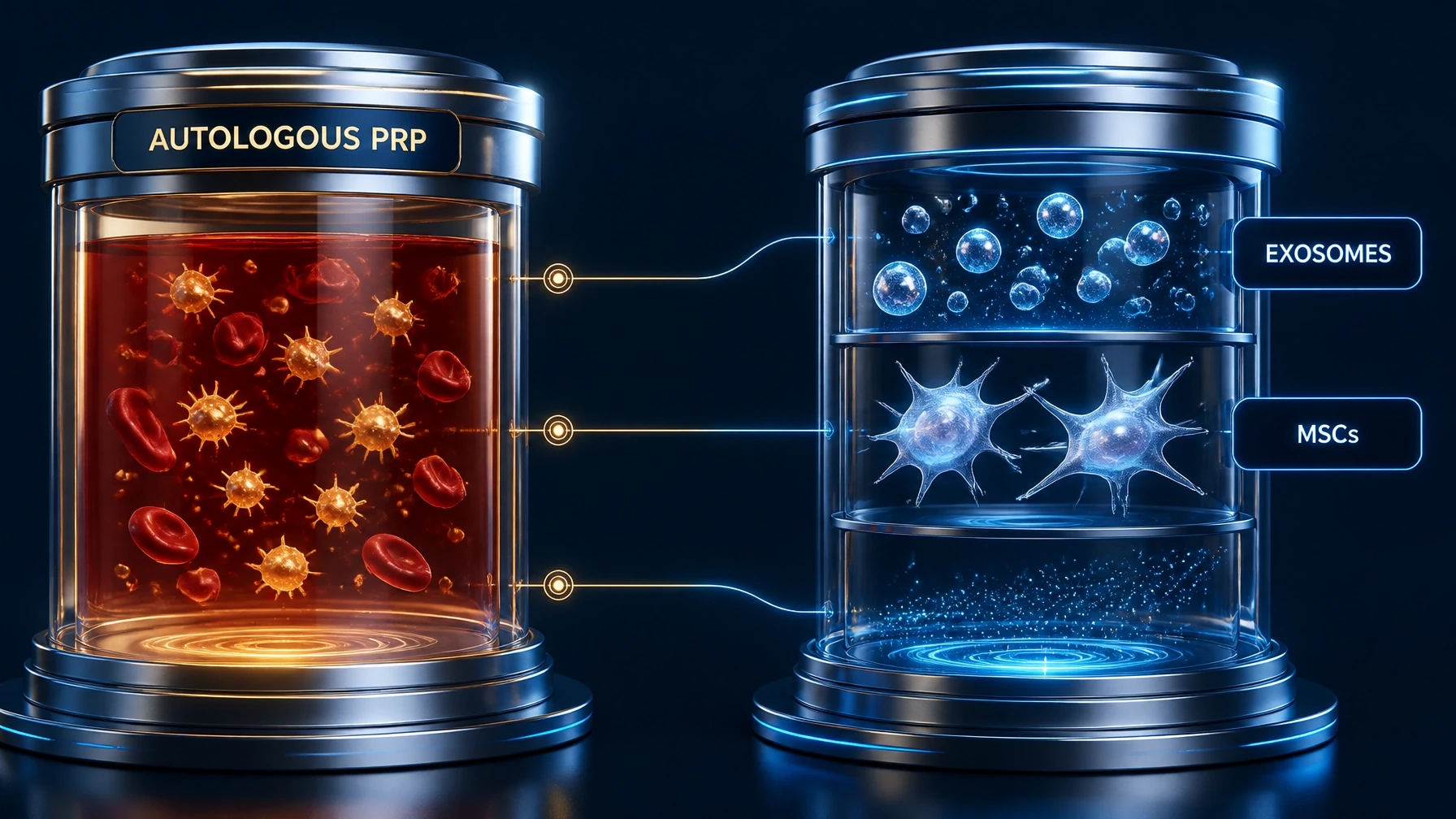
When we compared PRP with advanced exosomes and stem-cell-derived biologics, the distinction was obvious.
PRP is autologous, meaning it comes from the patient.
Exosomes and stem cells are allogeneic, meaning they are derived from another donor or donor source. Their appeal is consistency and concentration. Depending on the product and its processing, they may contain extracellular vesicles carrying proteins, lipids, messenger RNA, and microRNA.
I often describe exosomes as the mail system of the cell.
Cells send messages to one another. Exosomes are among the vehicles involved in that communication. They may influence how recipient cells respond to stress, inflammation, repair, and differentiation.
PRP is more like asking your own local repair department to get organized.
Exosome-based biologics may provide a larger, more standardized package of signaling information. But here is where the wellness industry usually begins tap dancing around the truth:
Not every product labeled “exosome” is equivalent. Not every product has robust human clinical evidence. Not every advanced biologic is FDA-approved for every use being promoted. In fact, at the present time no advanced biologic is FDA-approved for any specific condition, but they are approved for use under the right conditions.
The same caution applies to stem-cell-related therapies. A biologic can be promising without being proven for every condition. “Advanced” does not mean “magical.” It means the biology is more complex and the need for quality control, informed consent, sourcing, and regulatory compliance is even greater.
PRP has limitations, but its origin is clear. It comes from the patient’s own blood. That reduces the extremely low risks associated with various biologics, however at present there are no known risks associated with them at all. That does not eliminate the ordinary risks of an injection: pain, swelling, bruising, infection, bleeding, or injury to nearby structures: but it does make the product inherently personal.
The limitation is equally clear:
You cannot extract a youthful biological environment from an aging body simply by putting it in a centrifuge.
If a patient is older, inflamed, undernourished, sedentary, sleep-deprived, or metabolically compromised, the quality of the PRP will reflect those realities.
That does not make PRP useless. It means the treatment must be selected and supported intelligently.
The Gatekeeper Problem: When Cost Becomes the Treatment Plan
Regenerative medicine is not only a scientific question. It is also an access question.
I have met patients with chronic tendinopathy, arthritic knees, shoulder injuries, and progressive hair loss who were appropriate candidates for regenerative support but could not justify the cost of the most advanced protocols.
What were they supposed to do?
Wait another year while the tendon degenerates? Continue using medication to mask symptoms? Receive repeated corticosteroid injections that speed joint degeneration? Hope the joint politely stops deteriorating out of respect for their budget?
A therapy is not useful to a patient if the patient cannot realistically access it.
That is why we are adding PRP to our regenerative injection protocols in Sarasota. It creates another entry point.
For selected patients, PRP may be appropriate for:
- Mild-to-moderate knee osteoarthritis
- Chronic lateral epicondylitis, commonly called tennis elbow
- Chronic medial epicondylitis, commonly called golfer’s elbow
- Certain mild or moderate tendon injuries
- Selected ligament or joint-support problems
- Some cases of plantar fascia or other chronic soft-tissue degeneration
- Early-stage hair loss or selected aesthetic applications to enhance skin tone, texture, and resilience, with realistic expectations of course
The evidence is not equally strong for every condition. The best-supported uses tend to be condition-specific, especially mild-to-moderate knee osteoarthritis and lateral epicondylitis. Evidence for Achilles tendinopathy, rotator cuff problems, generalized sports injuries, and cosmetic anti-aging applications is more variable.
That is precisely why consultation matters.
PRP Versus Corticosteroids
Corticosteroid injections can reduce pain quickly. That is their appeal.
But quick symptom relief is not the same as structural repair.
Repeated or even a single corticosteroid (steroid) injection has been documented to contribute to cartilage loss or tendon weakening, particularly when used too frequently or injected directly into vulnerable tendon tissue. A widely cited randomized trial published in JAMA found that repeated triamcinolone injections for knee osteoarthritis resulted in greater cartilage volume loss than saline, without superior long-term pain relief.
That does not mean one cortisone injection automatically destroys a joint although it will speed degeneration. Medicine is rarely that binary. It does mean the “just keep injecting it” strategy deserves scrutiny.
Relief is not repair.
PRP Versus NSAIDs
NSAIDs can be useful medications for short-term pain and inflammation. They are not evil potions. They are also not tissue-rebuilding therapies.
They may reduce pain enough to allow movement, but they do not restore damaged ligament structure, rebuild a chronically degenerated tendon, or regenerate cartilage. Long-term use may also carry gastrointestinal, kidney, cardiovascular, and other risks depending on the patient.
I’m not saying whether medication is a viable option, for some it may be their only option. The question is whether the treatment addresses the underlying problem and NSAIDs do not.
At ARTC, we are interested in the transition from degeneration to regeneration: while recognizing that no injection can substitute for appropriate rehabilitation, nutrition, metabolic support, sleep, and mechanical correction.
The New Strategy: PRP as the Foundation
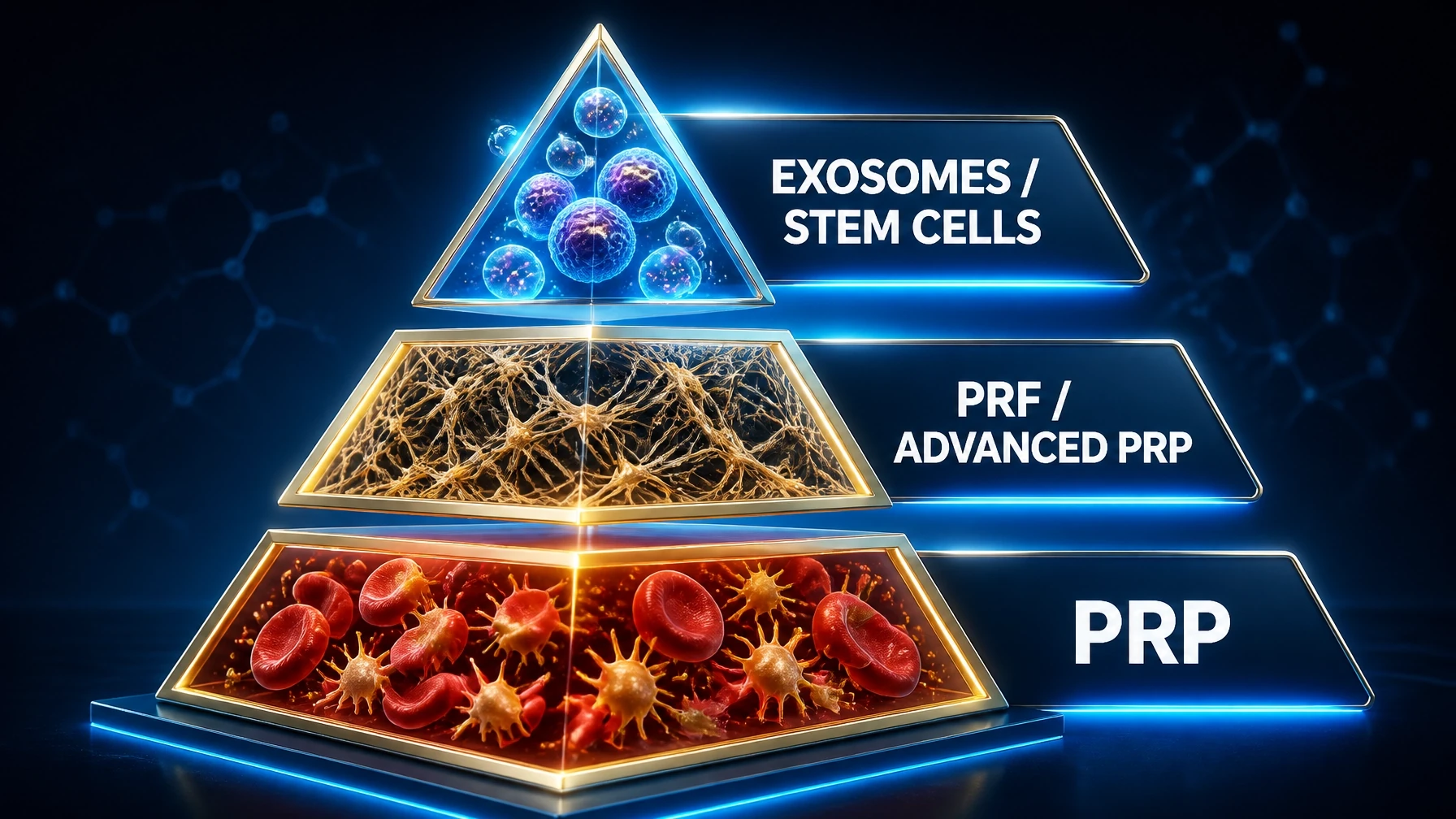
We are restructuring our approach into a spectrum of regenerative support.
Think of it as a pyramid: not because healthcare needs more pyramids, but because the foundation determines whether the structure stands.
Level One: PRP for Appropriate Entry-Level Cases
For a budget-conscious patient with moderate osteoarthritis, a mild tendon injury, or early-stage hair loss, PRP may provide a reasonable starting point.
It uses the patient’s own biological material and delivers a concentrated collection of platelet-derived signals to a selected treatment area.
It is not the strongest tool in our toolbox. It may not be sufficient for advanced degeneration. It is not appropriate for every patient or every diagnosis.
But PRP is substantially better than doing nothing while a treatable problem continues to progress.
Level Two: PRF and Advanced PRP
Platelet-Rich Fibrin, or PRF, is a related approach that emphasizes a fibrin matrix and a more sustained release of signaling molecules. PRF is made by modifying the PRP with additional processing. Advanced PRP preparations may also differ in platelet concentration, leukocyte content, activation, and processing.
The right preparation depends on the tissue, the diagnosis, and the intended biological response.
This is where the phrase “one-size-fits-all” should be buried permanently. A knee joint, a tendon attachment, a scalp, and a ligament do not have identical biology. They should not automatically receive identical protocols.
Level Three: Exosomes and Stem-Cell-Derived Biologics
For more advanced cases, or when the clinical goal requires a higher level of signaling support, exosomes or stem-cell-derived biologics should be considered.
These therapies remain more expensive and require greater scrutiny. The source, manufacturing standards, product characterization, regulatory status, and evidence must all be evaluated.
More expensive does not automatically mean more appropriate.
Sometimes the advanced option is warranted. Sometimes it is unnecessary. Sometimes the patient’s biology is not prepared to respond well to any biologic until circulation, nutrition, mitochondrial function, metabolic health, or mechanical instability is addressed.
The body is not a vending machine. Insert expensive biologic, receive perfect tendon repair.
The Primer Protocol: Preparing the Tissue Bed
One of the most practical applications of PRP is as a primer.
A patient may begin with PRP to stimulate local signaling, recruit repair activity, and improve the tissue environment. Then, after several weeks or months of biological and mechanical support, that patient may choose to pursue a more advanced exosome or stem-cell-derived protocol.
Using PRP first does not necessarily close the door to advanced biologics later.
In selected cases, it may help prepare the tissue bed.
This is not a guarantee. It is not a promise that PRP will make every future treatment work better. Human biology refuses to sign those contracts. But the concept is logical: a tissue environment that has better local signaling, improved blood flow, reduced chronic inflammatory burden, and more organized repair activity may be more receptive to a subsequent intervention.
That is why I view PRP as a gateway: not a consolation prize.
Safety Without Overselling
We are adding PRP because we believe in access, not because we are lowering our standards.
We will continue to use appropriate patient screening, high-quality centrifuge systems, sterile technique, precise anatomical placement, and individualized treatment planning.
We also will not tell every patient that PRP is the right choice. Some patients need a different intervention. Some need imaging. Some need rehabilitation first. Some may have advanced structural damage where surgery remains the most appropriate option. A consultation is where those distinctions are made.
Our approach to regenerative medicine includes the injection, but it does not stop there. The Wolverine Healing Protocol may include supportive nutrition, circulation-focused therapies, shockwave therapy, light-based therapies, decompression, rehabilitation, and other interventions based on the patient’s needs.
For patients interested in broader signaling and recovery support, we also provide physician-supervised peptide therapy in Sarasota. Again, the goal is not to collect therapies like trading cards. The goal is to match the intervention to the biology.
The Bottom Line
I am bringing PRP back to our core protocols because regenerative medicine should not be reserved exclusively for people with unlimited financial resources.
We are compromising on exclusivity.
We are not compromising on safety or effectiveness.
PRP is not the penthouse. It is the foundation. For the right patient, it may be a meaningful first step toward better tissue signaling, improved function, and a more comprehensive regenerative plan.
If you have chronic joint pain, tendon degeneration, early hair loss, or an injury that has not responded to conventional care, the next step is not to order a mystery vial from the internet and hope your biology enjoys surprises.
The next step is a proper evaluation.
Contact the Age Reversal Technology Center at (941) 806-5511, visit ARTC.health, or email info@artc.health to discuss whether PRP therapy in Sarasota is appropriate for you.
For nutritional products and foundational support, visit MyBodySymphony.com.
The right regenerative treatment is not necessarily the newest, most expensive, or most aggressively advertised. It is the one that fits the patient, the tissue, the biology, and the goal.
That is the standard.
And sometimes, the gateway to regeneration begins with something your body already carries.
Important Medical Notice
PRP is not appropriate for everyone, and outcomes vary by diagnosis, tissue quality, age, health status, preparation method, and treatment plan. PRP has stronger evidence for some conditions than others. It is not guaranteed to regenerate cartilage, eliminate pain, prevent surgery, or reverse aging. A qualified medical evaluation is necessary before treatment. This article is for educational purposes and is not a substitute for individualized medical advice.
Selected References and Further Reading
- American Academy of Orthopaedic Surgeons: Platelet-Rich Plasma (PRP)
- Johns Hopkins Medicine: Platelet-Rich Plasma (PRP) Treatment
- Platelet-Rich Plasma: Evidence, Preparation, and Clinical Applications
- PRP in Aesthetic Dermatology: A Review of Recent Applications
- Mayo Clinic: PRP and Bone Marrow Aspirate Concentrate for Knee Osteoarthritis
“`