

By: Dr. Max MacCloud, DO, ND, PhD
Quick answer: Prolotherapy strengthens loose or painful ligaments and tendons, PRP concentrates your own platelets to signal tissue repair, and stem cell or other cell-based therapies deliver more complex signals for advanced cartilage damage. The right choice depends on the diagnosis, the tissue involved, and how severe the damage is. Start with an evaluation for non-surgical joint pain treatment in Sarasota.
If you have chronic joint pain, you may have been offered three choices: take an anti-inflammatory and wait, get a cortisone shot (steroid), or schedule surgery. That is a remarkably small menu for our remarkably complicated joints.
Regenerative injections add options, but prolotherapy vs PRP vs stem cells is not a choice between three brands of the same treatment. Prolotherapy, platelet-rich plasma (PRP), and cell-based therapies work at different levels, have different evidence, and suit different problems. The best choice is not the most expensive injection. It is the best match for the tissue involved, the severity of the damage, your biology, and your goals.
I have spent more than three decades working with regenerative injection therapies. My first rule is simple: diagnosis comes before injection, every time. A joint is not a tire, and injections are not air. You need a proper physical examination, appropriate imaging when indicated, and a working diagnosis before anyone recommends an injection.
What Is the Difference Between Prolotherapy, PRP, and Stem Cells?
Prolotherapy strengthens weakened ligaments and tendons, PRP concentrates your own platelets to signal repair, and cell-based therapies deliver more complex biological signals for deeper damage. Think of these treatments as a spectrum of biological intensity, not a podium where the top tier automatically wins. At ARTC, we describe them as the Regenerative Injection Pyramid: prolotherapy forms the structural base, PRP is the foundational biologic pillar, and cell-based options sit at the top.
The pyramid is about how a treatment is used, not proof that the highest tier works best for everyone. There is no universally “best” injection. There is a best match.
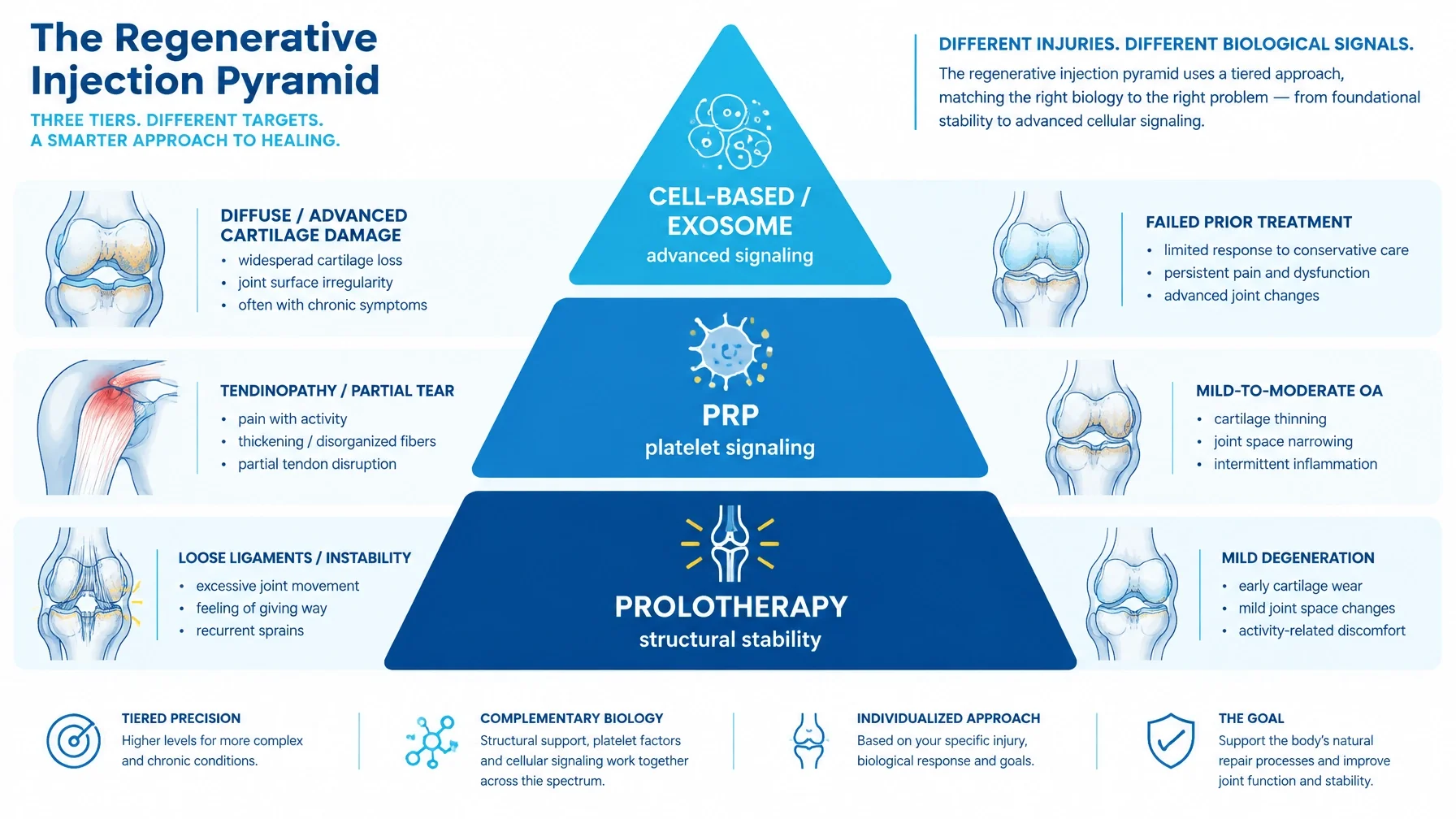
Tier 1: Prolotherapy, the structural foundation
Prolotherapy typically uses a dextrose solution injected at weakened ligament or tendon attachment points, called entheses. The goal is to provoke a controlled, local healing response. In plain language, it is intended to encourage the repair cascade where connective tissue meets bone.
That makes prolotherapy most relevant when the joint is unstable or its supporting tissues are painful, rather than when the main issue is extensive cartilage loss. It may be considered for ligament laxity, hypermobility-related symptoms, chronic tendon or enthesis pain, some sacroiliac or lumbar ligament problems, and mild-to-moderate osteoarthritis.
The evidence is real, but mixed. In a 2013 randomized knee osteoarthritis trial, dextrose prolotherapy improved symptoms compared with saline injections and home exercise at one year. A 2004 randomized study of chronic low-back pain found clear benefit of the glucose solution over just saline injections. That doesn’t mean that prolotherapy on its own can claim to repair every painful back or rebuild cartilage. There’s more to it.
What it can do: support a repair response in weakened connective tissue and help improve stability, function, and pain.
What it cannot promise: rebuilding cartilage that is gone. It also usually requires multiple sessions and time for tissue remodeling. It is typically the least expensive tier, but “least expensive” does not mean appropriate for every diagnosis.
Tier 2: PRP, the foundational biologic pillar
PRP is made by concentrating platelets from a person’s own blood. Those platelets release signaling molecules, including PDGF, TGF-beta, VEGF, and IGF-1, that participate in tissue repair and inflammation. They also contain growth factors and collagens, however, the levels of these decline with age. For this reason, we also offer Nano PRP that contains those growth factors and collagens derived from placental tissue.
At ARTC, following our August decision, PRP is our foundational biologic pillar for regenerative injections. That does not mean that every patient needs it, or that it is the best choice for a given issue.
PRP is most often considered for tendinopathy, partial tendon injuries, mild-to-moderate knee osteoarthritis, plantar fasciitis, lateral epicondylitis (tennis elbow), and some partial ligament injuries. It is also a popular hair restoration procedure but that is of course a separate application in the scalp, not a joint-pain treatment.
The evidence is strongest in areas such as lateral epicondylitis and knee osteoarthritis, but the research is not tidy. Studies vary in platelet concentration and preparation, leukocyte content, number of injections, ultrasound guidance, and comparison treatments. A systematic review of PRP trials reported potential benefits for knee osteoarthritis and lateral epicondylitis, while also noting limitations in evidence quality. Another review of lateral epicondylitis found encouraging improvements but relied substantially on before-and-after comparisons, which cannot by themselves rule out natural recovery or placebo and procedure effects.
There is also a practical issue: PRP is autologous, meaning it comes from you. That is a safety advantage for many patients, but also a potency ceiling. Age, systemic inflammation, health conditions, and nutrition can influence platelet activity. A 60-year-old with poor metabolic health will not produce the same platelet profile as a healthy 25-year-old athlete. That does not mean PRP cannot help; it means the source material and expectations deserve an honest discussion. That is why for many of our older patients we recommend something stronger.
Leukocyte-rich PRP may cause more post-injection flare in some settings. Anticoagulants and NSAIDs can dramatically reduce the effectiveness of all regenerative injection therapies as they can shut down the body’s natural healing response. Other pain medications like Tylenol or opioids do not interfere with the healing response although they come with other concerns and precautions. Do not stop prescribed medication on your own. Review it with your treating clinician before a procedure.
PRP can signal repair, but it is not a replacement for a large cartilage defect.
Tier 3: Cell-based products and exosomes, greater healing potential and complexity, not guaranteed results
“Stem cell therapy” is an umbrella phrase that can conceal very different products. Ask exactly what is being injected.
- Bone-marrow aspirate concentrate (BMAC) is a point-of-care concentrate made from a patient’s bone marrow. It contains a mixture of cells and signaling factors; it is not a vial of purified stem cells. It will contain stem cells and various growth factors although the older a person is, the less viable and effective they will be.
- Adipose-derived stromal vascular fraction (SVF) is a mixed-cell preparation derived from fat tissue. Its regulatory status depends on how it is processed and intended to be used. Calling something “same-day” does not automatically make it compliant. Adipose-derived stem cells are also not the best choice for joint repair.
- Umbilical or Placental derived stem cells are young, viable cells and associated growth factors that are the primary thing that should be used. They have the greatest chance of success.
- Culture-expanded mesenchymal stromal/stem cell (MSC) products are processed and grown outside the body. These are not FDA-approved for injection into joints to treat osteoarthritis in the United States. Of course, none of these substances are FDA-approved as that requires a company to invest 1-2 billion dollars to take it through the approval process. No company will do that without being able to patent the product and human tissue products cannot be patented. Contrary to what many people think, umbilical stem cells do not become you or do the repairs directly. What they do is to provide a ‘software’ update to your stem cells as well as new battery packs from donated mitochondria.
- Exosomes are acellular particles that carry signals released by stem cells. They are not stem cells, but are considered as stem cell therapy. They contain a couple of hundred growth factors, cell signaling molecules, and messenger RNA. FDA states there are currently no FDA-approved exosome products, and it has warned about unapproved regenerative products. They are being used off label and for research purposes.
These approaches are of interest because their proposed effects involve signaling, immune modulation, and changes to the local tissue environment, not simply turning into replacement cartilage cells. But “cell-based” does not describe one uniform product. Cell identity, dose, viability, processing, sterility, and delivery all matter. No clinic should promise uniform results from a category this varied. It’s crucial that your provider obtain high-quality, viable cellular tissue products.
There have been over 1.2 million published studies on stem cell therapy. It has been used successfully in modern medicine for over 65 years, it just goes by a different name, bone marrow transplant that is used in the treatment of several types of cancer. They are not officially approved in the US for anything else although we are allowed to use them.
The top of the pyramid means greater biological complexity and potential, not definitive evidence. Some products may deliver a more standardized dose independent of a patient’s age, but that does not establish that a particular product is approved, effective, or appropriate for a particular joint.
Prolotherapy vs PRP vs Stem Cells at a Glance
| Prolotherapy | PRP | Stem cells / cell-based | |
|---|---|---|---|
| Mechanism | Dextrose triggers a controlled healing response where ligaments and tendons attach to bone | Concentrated platelets from your own blood release growth factors that signal repair | Cells and signaling molecules modulate inflammation and the local tissue environment |
| What it’s used for | Ligament laxity, joint instability, chronic tendon or enthesis pain, mild-to-moderate osteoarthritis | Tendinopathy, partial tendon tears, tennis elbow, plantar fasciitis, mild-to-moderate knee osteoarthritis | Advanced or diffuse cartilage loss, or when prolotherapy or PRP has plateaued |
| Evidence level | Real but mixed: randomized trials in knee osteoarthritis and low-back pain | Strongest for tennis elbow and knee osteoarthritis; studies vary in preparation and dosing | Promising but varies widely by product; not definitive |
| FDA status | Dextrose is an approved drug; injecting it for joint pain is off-label | Prepared from your own blood; joint use is off-label | No exosome products and no culture-expanded stem cell products are FDA-approved for joints |
| How it’s given | Injected at weakened attachment points; usually multiple sessions | Blood drawn, concentrated, and injected into the joint or tendon | Bone marrow or fat from your own body, or donor umbilical/placental tissue, injected into the joint |
Prolotherapy vs PRP vs Stem Cells: Which Treatment Fits Which Problem?
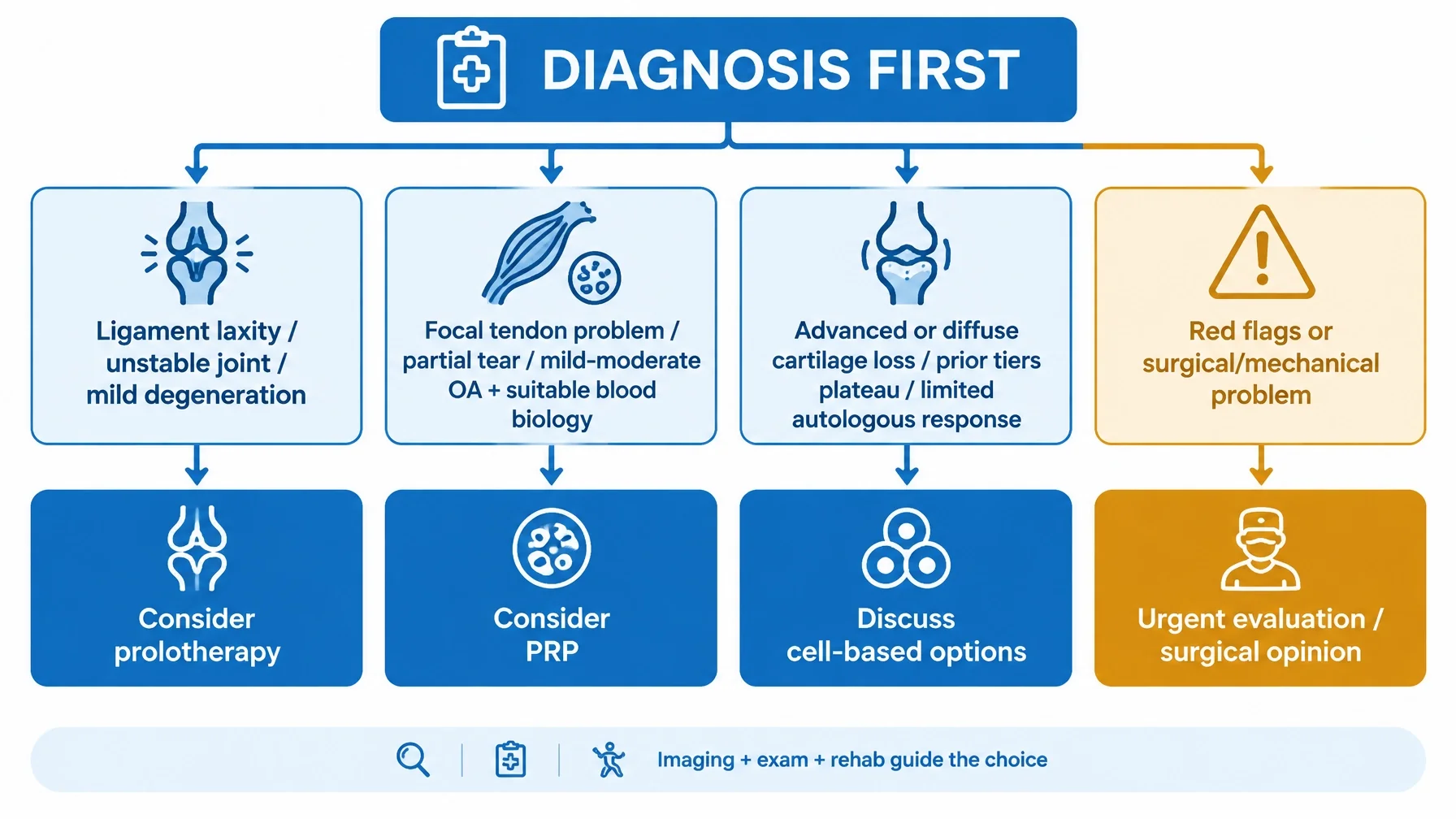
The right tier depends on the problem: prolotherapy for instability, PRP for tendon injuries and mild-to-moderate arthritis, and cell-based options for advanced cartilage loss or when lower tiers have plateaued. Use this as a starting framework for a clinical conversation, not a diagnosis you make from a blog post:
A PRP-first approach can sometimes be considered before a later cell-based treatment. The idea is to support local signaling and prepare the tissue environment. It is not a guaranteed primer, and it should not be sold as one. Starting with a lower tier does not necessarily burn a bridge; it may simply be the proportionate first step.
Loading and rehabilitation are part of the treatment. Injection type, volume, placement, experience, ultrasound guidance, and aftercare matter. So does what happens next. No injection outperforms the rehabilitation it is paired with. At ARTC, physician-supervised injections are considered within a broader plan, not as a substitute for assessment and follow-through.
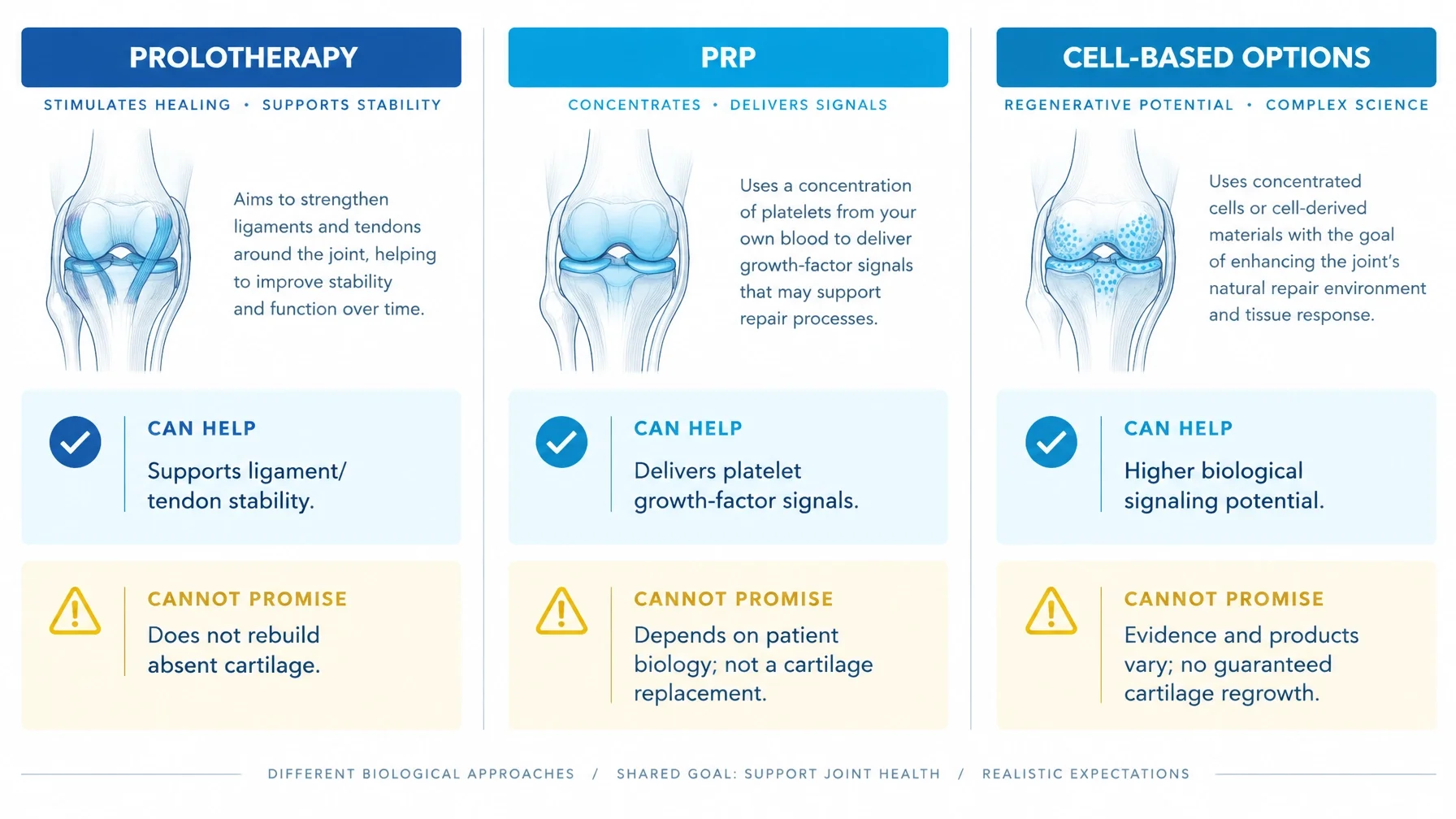
What an Injection Cannot Fix
Some problems need a different plan. An injection cannot reliably repair a meniscal injury that needs surgery, stabilize a fracture, treat a septic joint, reverse avascular necrosis, or remove nerve compression that is being mistaken for joint pain. It cannot fix a mechanical problem that has not been identified. And it cannot do the rehabilitation for you.
Cortisone belongs in a different conversation. It can provide short-term relief and may be appropriate in selected cases. But even a single injection and definitely repeated injections are not a tissue-repair strategy: a 2017 two-year randomized knee osteoarthritis trial in JAMA found greater cartilage loss with repeated corticosteroid injections than with saline, without better pain relief. The problem is not medication. It is lazy medicine that repeats the same intervention without reassessing the problem.
Safety, Red Flags, and Realistic Expectations
Active infection, including infection of the joint or skin over the injection site, is a reason not to proceed until it is addressed. Clinicians also need to review active malignancy, significant immunosuppression, poorly controlled diabetes, bleeding disorders, anticoagulants, allergies to the proposed materials, and pregnancy. These issues do not all carry the same risk in every situation; they require individualized medical judgment. Unrealistic expectations matter too. No injection guarantees pain relief, cartilage regrowth, or avoidance of surgery.
Seek urgent medical care for a hot, red, rapidly swelling joint with fever; sudden inability to bear weight after an injury; severe pain after a procedure; or new weakness, numbness, or loss of bladder or bowel control. Do not wait for a regenerative consultation to assess an emergency.
These treatments aim to improve pain and function. Changes typically unfold over weeks to months, results vary, and some people do not respond. No ARTC therapy should be presented as a guarantee of cartilage regrowth or surgical avoidance.
The Body Still Has to Do the Building
An injection is a signal. Tissue repair still depends on a body with adequate blood supply, mitochondrial capacity, metabolic balance, metabolic reserve, and healthy cell membranes. At ARTC, we use the 5Ms framework (microvascular health, mitochondrial health, metabolic balance, metabolic reserve, and membrane health) to help assess the broader environment. The signal is only part of the job; the tissue needs delivery systems and raw materials too.
That’s why an injection may be placed within the Wolverine Healing Protocol: a personalized system that can include oxygen therapies for delivery, clinician-supervised peptide support for signaling, adaptive resistance training for appropriate loading, and nutrition and sleep for recovery. These are not magic add-ons. They are considerations to assess and individualize.
Peptide therapy is often discussed as an adjunct, but many peptides promoted for recovery remain investigational and are not established, FDA-approved joint treatments. Once again, since peptides can’t be patented, no one is going to invest to get them approved. Evidence and regulatory status vary by compound. Any consideration should be clinician-supervised, without assuming benefit or replacing proven rehabilitation.
For more on ARTC’s approach, explore non-surgical joint repair, regenerative medicine in Sarasota, and the microvascular health assessment. Additional context: mitochondrial health, adaptive resistance training, EWOT, HBOT, and peptide therapy in Sarasota.
Does Insurance Cover Prolotherapy, PRP, or Stem Cells?
Regenerative care is almost always paid out of pocket since insurance typically does not cover it since it is not the ‘standard of care’. That matters because it limits many people from benefitting. Nobody should be priced out of a thoughtful evaluation, which is one reason a tiered approach matters: not every patient needs the most expensive option. Ask for the diagnosis, the rationale for the proposed tier, the exact product, the total cost, the alternatives, and what happens if the treatment does not help. A $6,000 injection without a diagnosis is not precision medicine. It is an expensive guess with better lighting.
Biological Sovereignty means your tissue, your data, your decision. Insurance rules do not determine what your joint needs. But neither does a sales pitch. A good clinician should explain the evidence, the limitations, and when a surgeon is the right referral. Sometimes the honest answer is that an injection is not the right answer.
Frequently Asked Questions
Which is best for knee arthritis: prolotherapy, PRP, or stem cells?
It depends on how advanced the arthritis is. For mild-to-moderate knee osteoarthritis, prolotherapy for knee pain and PRP both have randomized-trial support. For advanced or diffuse cartilage loss, or when those have plateaued, a cell-based option may be considered. A diagnosis should come first, as laid out in our 5-step non-surgical knee pain treatment framework.
Is prolotherapy or PRP more effective?
Neither is more effective across the board, because they treat different problems. Prolotherapy targets loose or painful ligament and tendon attachments. PRP delivers concentrated platelet signals and has its strongest evidence in tennis elbow and knee osteoarthritis. PRP results also depend on your age and metabolic health, since the platelets come from your own blood.
How many sessions do prolotherapy, PRP, and stem cell therapy for joints take?
The number of sessions varies by treatment and diagnosis. Prolotherapy usually requires multiple sessions spaced out to allow tissue remodeling. PRP studies vary in how many injections they use, and cell-based plans depend on the product chosen. With all three, changes typically unfold over weeks to months, and rehabilitation is part of the plan.
Can prolotherapy, PRP, and stem cells be combined?
Yes, they can be used in sequence. A PRP-first approach is sometimes considered before a later stem cell therapy treatment to support local signaling and prepare the tissue. Starting with a lower tier does not rule out a higher one later. Combining tiers is not a guaranteed primer, and it should be planned around your diagnosis.
If you are weighing prolotherapy vs PRP vs stem cells for chronic pain, start with an evaluation, not a package deal. Contact ARTC to discuss your symptoms, diagnosis, and options. We will help you understand which tier may fit, and tell you when it does not.
Your move.
Sources and References
- Rabago D, et al. Dextrose prolotherapy for knee osteoarthritis: a randomized controlled trial. Annals of Family Medicine. 2013.
- Yelland MJ, et al. Prolotherapy injections, saline injections, and exercises for chronic low-back pain: a randomized trial. Spine. 2004.
- Fitzpatrick J, et al. Comparative analysis of leukocyte-poor vs leukocyte-rich PRP for lateral epicondylitis. 2021.
- Belk JW, et al. Impact of platelet-rich plasma use on pain in orthopaedic surgery: a systematic review and meta-analysis. 2019.
- Mautner K, et al. Cell-based versus corticosteroid injections for knee pain in osteoarthritis: a randomized phase 3 trial. 2023.
- Anz AW, et al. Bone marrow aspirate concentrate injections versus viscosupplementation for knee osteoarthritis: randomized controlled trial. 2022.
- McAlindon TE, et al. Effect of intra-articular triamcinolone vs saline on knee cartilage volume and pain. JAMA. 2017.
- U.S. Food and Drug Administration. Consumer alert on regenerative medicine products, including stem cells and exosomes.
- U.S. Food and Drug Administration. Public safety alert on unapproved stem cell and exosome products.
Medical Disclaimer
This article is for educational purposes only and is not medical advice, diagnosis, or a substitute for care from a qualified clinician. Treatment suitability and risks depend on individual history, examination, imaging, and the specific product or procedure considered. Regenerative injections may not be appropriate for everyone; results vary, and no outcome is guaranteed. Seek urgent medical care for potentially serious symptoms.
“`