

By: Dr. Max MacCloud [DO, ND, PhD]
There comes a moment in every health optimization expert’s life when you realize the pharmaceutical industry has finally built something more addictive than Instagram. In reality, they found something “natural” and modified it to make it more effective and patentable.
I’m talking, of course, about the GLP-1 arms race — the semaglutide vs tirzepatide vs retatrutide showdown — the single greatest transfer of wealth from suburban waistlines to pharmaceutical shareholders since the invention of the Dorito. We started with semaglutide, which was basically a chemical way to forget that food exists. Then came tirzepatide, which added a second hormone because apparently one wasn’t enough to ruin Thanksgiving. And now we have retatrutide, the triple agonist, which hits so many receptors simultaneously that I’m pretty sure it qualifies as a polyamorous relationship with your endocrine system.
If you’re reading this, you’ve probably already injected something into your thigh that costs more than your car payment. Or you’re thinking about it. Or you’re currently rage-scrolling because your compounding pharmacy just sent you an email that starts with “Due to unprecedented demand…” and ends with you crying into a protein shake.
If you are exploring advanced options like peptide therapy in Sarasota or looking into semaglutide in Sarasota, you need more than marketing hype. You need hard clinical truth.
So let’s settle this once and for all: semaglutide vs tirzepatide vs retatrutide. Which one is the “best”? Which one is the “optimization” choice? Which one will help you increase your healthspan versus which one will simply make you thin enough to fit into the coffin slightly more comfortably?
Grab a coffee if you need it. Or don’t — your appetite is probably already dead anyway.
The Scale Is a Pathological Liar
Let me tell you a horror story. A 52-year-old executive walks into my office — or, more accurately, Zooms in from his home gym, which has approximately $14,000 worth of equipment he uses twice a month. He’s beaming. He’s down 34 pounds on his latest weekly injection. His suits fit again. His traditional doctor is thrilled. His Instagram carousel is going to crush.
Then I look at his body composition scan.
He’s lost 21 pounds of fat. Excellent. Truly. Chef’s kiss. He’s also lost 13 pounds of lean mass. Thirteen. That’s not a rounding error. That’s a small dog. That’s the functional equivalent of deciding to renovate your house by burning down a load-bearing wall because you didn’t like the paint color.
Welcome to the dirty secret of modern weight loss pharmacology: the scale is lying to you, your muscles are leaving, and nobody in the corporate marketing department is losing sleep over it.
Contestant #1: Semaglutide (Ozempic/Wegovy) — The Original Appetite Assassin
Let’s start with the granddaddy of them all. Semaglutide is a selective GLP-1 receptor agonist. Translation: it mimics a hormone your gut releases after you eat, telling your brain, “Hey, we’re good, no need to hoover that entire bread basket.” It also slows gastric emptying, which is a polite medical way of saying it turns your stomach into a traffic jam.
What it actually does:
- Suppresses appetite like a Soviet censor.
- Slows digestion so you feel full longer.
- Reduces HbA1c, fasting glucose, and the general feeling that your pancreas is staging a labor strike.
The weight loss: About 15% of body weight on average in the STEP 1 trial. Respectable. Not flashy. The Honda Civic of metabolic drugs — reliable, ubiquitous, and currently being prescribed to your neighbor’s Pomeranian by a telehealth doctor in Nevada.
The dark side: It eats muscle. Across virtually every weight loss intervention ever studied, approximately 20 to 40 percent of the weight you lose comes from lean tissue, not fat. In the STEP 1 body-composition data, participants lost roughly 23 pounds of fat and 15 pounds of lean muscle. That’s not body recomposition. That’s a hostile takeover where the fat leaves but takes a chunk out of your functional strength as collateral damage.
The vibe: Semaglutide is like hiring a bouncer who stands at the door of an all-you-can-eat buffet and physically prevents you from entering. Effective? Yes. Elegant? No. And the bouncer has absolutely no interest in whether you can still get off the toilet unassisted at age 70.
For those researching specifics on these options, our detailed breakdown on best weight loss peptides dives deeper into how to navigate these mechanisms without destroying your physique.
Contestant #2: Tirzepatide (Mounjaro/Zepbound) — The Overachiever With a Dual Degree
Eli Lilly looked at semaglutide and said, “Cute. But what if we added another hormone agonist?” Enter tirzepatide, a dual GIP/GLP-1 receptor agonist. GIP, or glucose-dependent insulinotropic polypeptide, is basically GLP-1’s less famous cousin who actually studied economics in college. It helps with insulin secretion, metabolic flexibility, and maybe — maybe — makes the weight loss process slightly less catastrophic for your lean mass.
What it actually does:
- Everything semaglutide does, but with superior metabolic housekeeping.
- The GIP component improves how your body handles glucose and lipids in adipose tissue.
- In the SURMOUNT-1 trial, average weight loss hit about 20–22.5% at the highest dose. That’s roughly equivalent to semaglutide showing up to a knife fight and tirzepatide bringing a flamethrower.
The dark side: It’s still an incretin-based drug that suppresses appetite, which means people still under-eat protein, which means they still lose muscle. The GIP component might be marginally protective, but you are still playing metabolic Jenga; tirzepatide just removes the blocks slightly more slowly. Also, the side effect profile is… enhanced. Nausea, vomiting, and the kind of GI distress that makes you wonder if your intestines are filing for divorce.
The vibe: Tirzepatide is semaglutide after it got an MBA. Smarter, more expensive, slightly more effective, and absolutely convinced it’s better than you. It will help you drop pounds, but it will also test your relationship with your digestive tract.
Contestant #3: Retatrutide — The Triple Threat That Actually Gets It
And now we arrive at the main event. Retatrutide adds a third receptor to the party: glucagon. Yes, that glucagon — the hormone usually associated with raising blood sugar and breaking down glycogen. On paper, this sounds insane. Why would you add a hormone that mobilizes stored energy to a drug designed for metabolic disease?
Because glucagon also increases energy expenditure and lipolysis. It raises your basal metabolic rate. It tells your body to burn stored fat for fuel. But here’s the part the marketing brochures miss: the glucagon component appears to work through the hypothalamus to actually reset your body’s metabolic set point. It rewires the neural circuitry governing hunger, satiety, and energy balance.

What it actually does:
- In the Phase 2 trial, participants lost up to 24% of body weight at high doses. That’s not weight loss; that’s body weight decimation.
- Visceral fat and liver fat reductions that border on miraculous. We’re talking profound liver fat clearance in responders.
- A metabolic effect that preserves resting energy expenditure better than its predecessors, because the glucagon agonism keeps your engine running hot even as you shrink.
The dark side: Yes, glucagon is catabolic. But the degree of muscle loss is driven by caloric deficit and protein intake, not the drug mechanism alone. When paired with proper resistance training — ideally utilizing advanced modalities like ARX adaptive resistance training — and adequate protein, muscle preservation is entirely achievable. Furthermore, when dosed intelligently at the lowest effective dose, retatrutide’s side effects are often smoother than tirzepatide because the glucagon counterbalances GLP-1 sluggishness.
The vibe: Retatrutide is not a bouncer. It’s a metabolic architect. It redesigns the building instead of just locking the doors. (One caveat the hype skips: retatrutide is still investigational and not yet FDA-approved — Lilly announced plans to file in early 2027.)
Anchoring the Protocol: The ARTC 5Ms Approach
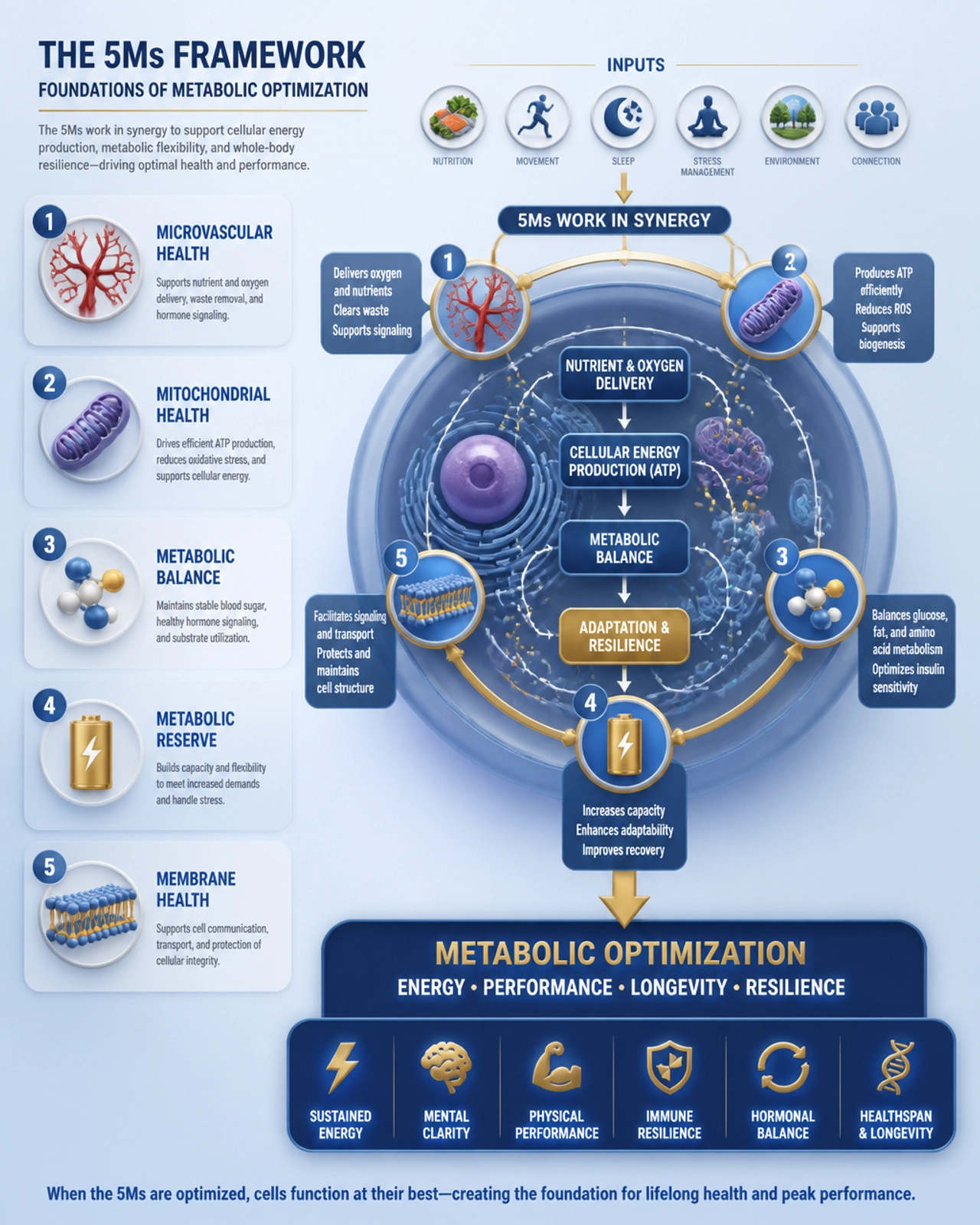
If you think you can inject your way to longevity while eating processed carbs and avoiding the gym, you are suffering from a severe deficit of common sense. At ARTC, we evaluate every therapeutic intervention through our pioneering 5Ms Framework. Real metabolic optimization requires fixing the core pillars of cellular physiology:
- Microvascular Health: Ensuring nutrient delivery and capillary integrity to every tissue in your body. Without microvascular health, your cells and mitochondria starve no matter how much protein and other nutrients you swallow.
- Mitochondrial Health: Optimizing cellular energy production. If your mitochondria are sluggish, fat burning remains a pipe dream. Everyone’s mitochondria are damaged in today’s high-stress environment.
- Metabolic Balance: Restoring insulin sensitivity and glycemic control so your endocrine system stops panicking every time you look at a carbohydrate. This is the foundation of homeostasis and health.
- Metabolic Reserve: Building and protecting lean muscle and organ mass so your body has a functional buffer against illness, aging, and physical stress.
- Membrane Health: Maintaining cellular fluidity, protection, and receptor sensitivity so hormones and signaling molecules actually work the way nature intended.
When you take a GLP-1 or retatrutide without addressing the 5Ms, you are just shrinking a dysfunctional organism. You become a smaller, weaker, more fragile version of your metabolically compromised self. That is not age reversal. That is slow demolition.
The Decision Matrix: Semaglutide vs Tirzepatide vs Retatrutide
So how do the three stack up head to head? Here’s semaglutide vs tirzepatide vs retatrutide at a glance:
| Metric | Semaglutide | Tirzepatide | Retatrutide |
|---|---|---|---|
| Avg Weight Loss | ~15% | ~20–22.5% | ~24% |
| Visceral Fat Reduction | Good | Better | Best |
| Liver Fat Reduction | Moderate | Good | Borderline miraculous |
| Metabolic Rate Impact | Drops significantly | Drops, but maybe less | Preserves / elevates rate |
| Hypothalamic Reset | No | No | Yes — the key differentiator |
| Side Effect Severity | Moderate | Moderate-to-severe | Moderate at low doses |
| Skill Required | Low | Medium | High |
Best Use Situations
- Semaglutide is for: The beginner who needs a reliable Honda Civic to drop 20–30 pounds without overcomplicating things.
- Tirzepatide is for: The insulin-resistant patient who plateaued on semaglutide and needs a heavier metabolic hammer.
- Retatrutide is for: The serious optimizer who wants a hypothalamic reset, dramatic visceral fat clearance, and is willing to lift heavy, eat 1–2g of protein per pound, and work with an expert clinical team to manage advanced protocols.
The Bottom Line
Semaglutide is the workhorse. Tirzepatide is the overachiever. Retatrutide is the metabolic architect. That’s the honest verdict of semaglutide vs tirzepatide vs retatrutide.
All three are revolutionary. But none of them replace the fundamental laws of human biology. Lift heavy things, consume adequate protein, protect your lean mass, and stop chasing the scale.
Stop Guessing. Start Optimizing.
If you’re ready to stop guessing and implement an evidence-based metabolic optimization protocol tailored to your unique biology, we’re here to help. Contact ARTC today — call (941) 806-5511 or email info@artc.health. For nutritional support, visit mybodysymphony.com.
Your move.